Sunday, December 09, 2007

Hoy en Parroquia San Cristóbal

Today is, of course, the Second Sunday of Advent, but at Parroquia San Cristóbal it is also Mother's Day Sunday. The Youth Choir sang an anthem, as did the Adult Choir. The Sunday School gave candy to all the women in the congregation, and Marissa recited a Mother's Day poem. The Youth Group, Luz de Mañana, presented several mothers of the parish with gifts in honor of their contributions to the Youth Group during the year, and the Lovely Mona was one of the recipients.
The Men's Fellowship presented a plaque to Mrs. Violet Seale, the Mother of the Year, and they served breakfast after the service. Lots of people who have been in the United States for the past four months have returned now that it's cold up North, and it's great to have them all back home. All in all a very nice Sunday.


These two parrots sit in this pine tree in front of the church every morning and greet me saying "aow, aow, aow, aow." They sound more like cats than parrots! The Lovely Mona snapped this shot of them when we arrived this morning. They are quite large and noisy.


During Advent a member of the congregation reads a short paragraph about Advent and then lights the appropriate candles on the Advent Wreath. This morning our Mother of the Year, Mrs. Violet Seale, did the honors.


The Procession. Lots of smoke, as usual!


The Youth Choir singing Florece Una Rosa (Lo, How A Rose E'er Blooming).


The Adult Choir singing That Wonderful Mother of Mine.

Mrs. Violet Seale, the Mother of the Year, receiving a corsage from last year's Mother of the Year (actually, Mrs. Clara Edwards is standing in for Mrs. Elfrida Beckford, Mother of the Year 2006, who is at home with a sprained ankle. Get well soon, Elfrida!).


Mrs. Violet Seale receives a plaque from the Men's Fellowship of St. Christopher's.


Mothers honored by Luz de Mañana, our Youth Group. Left to right: Mrs. Norma Blackman; Mrs. Xiomara Newman; Mrs. Sandra Edwards; Mrs. Mona Dresbach; and Mrs. Nora Johnson.


Sunday School presentation: a poem for Mothers.

After church

Mrs. Milray Barrow

Mrs. Doyle is back at church! We told her that she has fans all over the world and that they needed photographic proof that she is alright.


Mr. Albert Barrow and Mr. John Josiah serving breakfast


Mr. Vincent Smikle and Mr. Renaldo Olton serve coffee and chicha

Mrs. Seale at the Table of Honor


Folks enjoying breakfast


Saturday, December 08, 2007

¡Felicidades, Padre Pablo!

Today is the seventeenth anniversary of Padre Paul'sordination to the priesthood. Head over there congratulate him!

Feast of the Immaculate Conception and Día de las Madres


Queen of peace, pray for us!
Our gaze is directed toward you in great fear, to you do we turn with ever-more insistent faith in these times marked by many uncertainties and fears for the present and future of our planet.
Together we lift our confident and sorrowful petition to you, the first fruit of humanity redeemed by Christ, finally freed from the slavery of evil and sin: hear the cry of the pain of victims of war and so many forms of violence that bloody the earth. Clear away the darkness of sorrow and worry, of hate and vengeance. Open up our minds and hearts to faith and forgiveness!

Mother of mercy and hope: Help every human being of every race and culture to find and embrace Jesus, who came to earth in the mystery of Christmas to give us 'His' peace.
Mary, Queen of peace, give us Christ, true peace in the world!


Here in Panamá today is Mother's Day. This is a BIG DEAL here; a national holiday. Everything is closed, except for the 24 hour Grocery Stores. When I took Chompy on her walk this morning there was no traffic, and when I took my morning walk the streets were clear. Around 9:00 this morning some Mariachis appeared at our neighbor's house and serenaded the Mom. Tomorrow we will have our Mother's Day Celebration at San Cristóbal, complete with the Men's Fellowship's Presentation of the Mother of the Year. The Youth Choir will sing an anthem and I suspect that several members of the Sunday School will recite poems in honor of Mother. I'm looking forward to the service as we are only holding one service! YAY!

¡Feliz Día de las Madres! Happy Feast of the Immaculate Conception!

Friday, December 07, 2007

REAL Friday Red Mr. Peanut Bank and Gallito Mescalito Blogging

Red Mr. Peanut Bank Hello, Gallito Mescalito; how are things?
Gallito Mescalito ¡Shriek! Shrieky-shrieky-shriek.
Red Mr. Peanut Bank Well, I've noticed that, too, but you know how Padre feels about Advent.


Gallito Mescalito ¡Shriek! ¡Shrriieekk!
Red Mr. Peanut Bank That's right. He doesn't care what the rest of the neighborhood is doing; he only wants an Advent Wreath right now.


Gallito Mescalito ¡Shriek!
Red Mr. Peanut Bank Where did that Christmas decoration come from?


Gallito Mescalito ¡Shriek!
Red Mr. Peanut Bank And that! Where did that reindeer come from?


Gallito Mescalito ¡¡SHRRIIIEEEEKKK!!
Red Mr. Peanut Bank AAARRRGGGHH! Where did YOU come from¨_
TP Roll Santa Ho! Ho! Ho! Happy Advent!
Gallito Mescalito ¡Shriek!
Red Mr. Peanut Bank You need to get out of here for a few weeks!
TP Roll Santa Ho! Ho! Ho!


Mr. Chompy's Chewed-up Squeaky Kitty Toy Hey, Bank. Hey, Boid. 'sup?
Gallito Mescalito ¡Shriek!
Red Mr. Peanut Bank Oh, hello, Cat! We were discussing the season.
Mr. Chompy's Chewed-up Squeaky Kitty Toy I see dat da neighbohs all gots dere lights and trees up! An' as always, we only gots dat wreath.
Red Mr. Peanut Bank Well, we just chased the TP Santa away!
Mr. Chompy's Chewed-up Squeaky Kitty Toy Well, can't we have just a little decoration?
Gallito Mescalito ¡Shriek!
Red Mr. Peanut Bank Okay. I'll put up the Nacimiento Mola.


Gallito Mescalito ¡Shriek!
Mr. Chompy's Chewed-up Squeaky Kitty Toy Cool!
Miss Egyptian Hippo of Love Hi boys. Nice backdrop!
Red Mr. Peanut Bank Hello, Miss Egyptian Hippo of Love! We've been discussing the season.
Miss Egyptian Hippo of Love And Padre Mickey's obsession with Advent?
Gallito Mescalito ¡Shriek!
Mr. Chompy's Chewed-up Squeaky Kitty Toy Yup!
Miss Egyptian Hippo of Love Say, Red Mr. Peanut Bank, the doggy toys have been talking with me, as well as the rest of the cast, and they want to put on a Christmas Pageant. Would you supervise?
Gallito Mescalito ¡Shriek!
Mr. Chompy's Chewed-up Squeaky Kitty Toy Yeah!
Red Mr. Peanut Bank A Christmas Pageant!?! Well, I suppose so.
Gallito Mescalito ¡Shriek! ¡Shrriieekk!
Red Mr. Peanut Bank I'm sorry, Gallito Mescalito; there's no way on earth you could be the Narrator! Maybe you can be Gabriel...
Mr. Chompy's Chewed-up Squeaky Kitty Toy I WANNA BE AN ANGEL!!!
Red Mr. Peanut Bank You look more like a shepherd to me; the Chief Shepherd, but a shepherd nonetheless!
Miss Egyptian Hippo of Love Er, I think I'l go tell the others that you are casting right now.
Red Mr. Peanut Bank Okay. Thank you, Miss Egyptian Hippo of Love.
Gallito Mescalito ¡Shriek!
Mr. Chompy's Chewed-up Squeaky Kitty Toy I know wot yoo means. A shepherd anna angel. Wut's he tinkin'?


Mighty Moose of Vermont and El Penguino Hi, Everybody!
Everybody Hi, guys!
Mighty Moose of Vermont We hear that there may be a Christmas Pageant and we want to participate.
Mr. Chompy's Chewed-up Squeaky Kitty Toy Hey, Moose! You can be a cow at da manger!
Miss Egyptian Hippo of Love And El Penguino can be the Baby Jesus!
El Penguino ¿El Divino Niño? ¡PORfaVOR!
Red Mr. Peanut Bank Well, we're still casting. Don't worry.
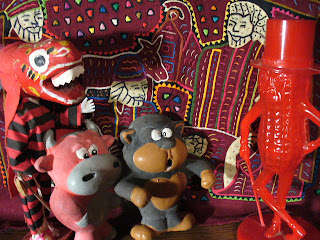


Diablito Sucio y ¡El Toro! ¡El Tres Reyes! ¡EL TRES REYES!
Squeaky Gorilla Yeah, we wanna be the Free Kings! , skeek
Red Mr. Peanut Bank I'm sorry, but this is a Christmas Pageant. The Three Kings appear at the Epiphany Pageant. What is that noise?
Squeaky Gorilla Sheesh! skeek You sure are strict!skeek What noise?skeek
Red Mr. Peanut Bank THAT NOISE! Look, you guys are going to be shepherds. The Wise Men show up at another pageant.
Diablito Sucio y ¡El Toro! ¿Pastores? ¡Está Bién!
Squeaky Gorilla Okayskeek We'll be shepherds. skeek But keep us in mind for the Epiphany Pageant! skeek


Red Mr. Peanut Bank Hello, Ladies! I suppose you both want to be the Blessed Virgin?
Wooden Kuna Doll Si, Señor.
Miss Egyptian Hippo of Love That's right, pal. And you'd best make the CORRECT decision!
Red Mr. Peanut Bank Give me a few days, ladies; give me a few days!


Telly Tubbies Wanna be in show! Wanna be in show!
Red Mr. Peanut Bank Sure, no problem. You four will be angels.
Telly Tubbies Yay! Big Hug!
Red Mr. Peanut Bank Sheesh!


Guatemalan Apocalyptic Angel Hi! I want to be a shepherd!
Red Mr. Peanut Bank Really? I thought that you would be Michael, the Commander of the Heavenly Host, Praising God and saying: Glory to God!
Guatemalan Apocalyptic Angel But I want to be a shepherd. Or a sheep! Or even a donkey!
Red Mr. Peanut Bank Well, let me think about this...


Toilet Paper Roll Santa Ho! Ho! Ho! I want to be Joseph!
Red Mr. Peanut Bank No! No! No! You won't be in this pageant!
Toilet Paper Roll Santa Darn! Darn! Darn!


Red Mr. Peanut Bank Bunrab! So good to see you! Are you willing to be in our Christmas Pageant?
Bunrab, the Filthiest Toy in the House Yes. I'd love a part if you can spare one.
Red Mr. Peanut Bank I think that you would be great as the Narrator. Also, would you be willing to help me write the script?
Bunrab, the Filthiest Toy in the House Sure! Hey, I think the rooster should play Joseph!
Red Mr. Peanut Bank Really? Why?
Bunrab, the Filthiest Toy in the House Because the Holy Family doesn't have any lines! It'll be great!
Red Mr. Peanut Bank We have a week ahead of us!

Will the casting make sense? Will a terrible fight break out between Wooden Kuna Doll and Miss Egyptian Hippo of Love? Will the Pageant include all of Mary Sue's favorite Christmas Carols? Can we drag this out for two more weeks? Tune in next week, hopefully, for answers to all these questions!!!

Friday Red Mr. Peanut Bank and Gallito Mescalito Blogging THE MOVIE!!!


Starring Miss Bebé, The World's Most Beautiful Granchile™ as herself
Gallito Mescalito makes an extremely brief appearance on the left side of your screen while Red Mr. Peanut Bank's head is introduced to Mr. Table.
Mumbly Voices: Tara Mobley, Chris Mobley, Matty Boy, Miss Stephenie Rose, and Padre Mickey
Background Music: Kajra Re from "Bunty aur Babli"
Filmed at Viceroy Restaurant in Berkeley, California, November 4, 2007

AARRRRGGGGHHHHHHHH!!!!!!

www.goingjesus.com


Thanks to PJ (she has a lot to answer for, believe you me!) I witnessed the Terror which is the Cavalcade of Bad Nativities or Nacimientos del Diablo.
Check it out, if you dare!

Friday Random Top Ten, No, Wait, Eleven!

Ya pushes "shuffle" and ya takes yer chances. . .

1. ESP Buzzcocks
2. Blue Lagoon Laurie Anderson
3. Harvest Neil Young
4. Gavotte (J.S. Bach) Amsterdam Baroque Orchestra
5. Ella Bebe
6. There She Goes Again The Velvet Underground & Nico
7. Ana Maná
8. Psalm 92: Dominus Regnavit/Studium Divinitatis (Hildegard Von Bingen) Anonymous 4
9. Journey To The Center Of The Mind RAMONES!!!!!
10. Seventeen The Sex Pistols
Super Groovy Bonus Track not picked by the shuffle but by Padre:
11. You Got It (Release It) Pearl Harbour & the Explosions

So, in honor of Tom Waits' Birthday it appears that the shuffle gave him the day off.
That first track is one of the greatest songs ever written by one of the greatest bands to walk the earth. The guitar riff goes on and on and on and on and the chords and everything just move around that riff. Nuttin' bettah! I see that our friends The Amsterdam Baroque Orchestra have made a return visit; I guess they enjoyed being on the list last week. Following Ella with There She Goes Again is sheer genius on the part of the shuffle! Also, Sex Pistols following the RAMONES jest like really happened. I couldn't help but add that last one.

Feast of St. Ambrose of Milan, Bishop

O God, you gave your servant Ambrose grace eloquently to proclaim your righteousness in the great congregation, and fearlessly to bear reproach for the honor of your Name: Mercifully grant to all bishops and pastors such excellence in preaching and faithfulness in ministering your Word, that your people may be partakers with them of the glory that shall be revealed; through Jesus Christ our Lord, who lives and reigns with you and the Holy Spirit, one God, now and for ever. Amen.


Ambrose was born in the year 337 to a Christian family. His father, Aurelius, was Prefect of Gaul, governing all of Britain, France, Spain,Portugal, part of Germany, and the islands of Sardinia, Corsica, and Sicily. His father’s palace was in Trier, Germany, but his mother had a palace in Rome. Ambrose spent part of the year in Germany and part in Rome. According to his biographer, Paulinus, the pope and other important bishops used to visit his mother’s palace regularly. One day the ladies of the house were kissing the hands of the bishops, and young Ambrose, holding out his hand, mocked them and said, “You should do the same for me since I am going to be a bishop.” He was very close to his siblings, Marcellina and Satyrus. When his sister Marcellina took a vow of virginity, he did the same, and both Ambrose and Satyrus followed in their father’s footsteps, studying literature, law, and rhetoric in Rome and they both served as barristers in the Court of the Praetorian Prefect of Italy. They were both appointed Prefects.

Ambrose was appointed Prefect of the province of Aemilia-Liguria in Upper Italy, with its headquarters in Milan. Ambrose was a good administrator and a popular governor. In the year 374, Auxentius, the bishop of Milan, died. The Church in Milan was divided between those who were loyal to the Nicene Creed and those who supported the ideas of Arius. The Nicene and Arian parties of the Church in Milan prepared to fight for their particular candidates to be elected bishop. We’ve talked before about how the people of that era would actually fight and come to blows over theology and dogma, and the situation in Milan threatened to turn violent. Ambrose, the prefect, went to the basilica in Milan to try to prevent an uproar. He spoke to those gathered at the basilica and he didn’t take sides in the dispute. Suddenly someone shouted “Ambrose for bishop!” The cry was taken up by others and Ambrose was elected bishop. He was not interested in the position, plus, he wasn’t even a baptized Christian, let alone clergy! He pushed his way out of the cathedral and headed back to his palace. He figured that if he proved himself to be as cruel and evil as the Emperor Valentinian. He ordered some prisoners to be tortured, figuring that this would convince the people that they had made a mistake in their choice, but the crowed followed him around Milan, saying, “Your sin be on us!” He invited Women of Loose Virtue to his palace, yet the crowd still shouted “Your sin be on us!” Then he told them that he was going to retire from the world and become a hermit, but no one was buying it. Finally, he decided to make a break for it and snuck out the side door of the palace late one night to escape. It was a moonless night and he took the wrong road and got lost. In the morning he discovered his mistake; he was entering Milan through the Roman gate. This time he was kept under “Palace Arrest;” a guard kept watch while a messenger was sent to Valentinian, explaining what was going on and requesting an imperial seal on the people’s decision. Valentinan probably had his reasons for getting Ambrose out of the position of Prefect, and so he sent a fast courier to give the Christians of Milan his assent to Ambrose’s episcopacy. However, Ambrose had made another break for it and was hiding at his friend, Leontius’ country house. The Pope got involved and ordered that anyone harboring Ambrose must, under pain of severe punishment, give him up immediately (which was the Christian thing to do, of course!). That was too much for Leontius, who turned his good buddy Ambrose in to the authorities. Ambrose was arrested and led back to Milan under armed guard.

Ambrose’ elevation to bishop took place over six days. First, he was baptized, then moved through the minor orders: appointed to doorkeeper one day; the next day appointed Lector; the following day appointed to the office of exorcist; the next day he became a subdeacon. On the last three days he was ordained deacon, priest, and finally, bishop. No one had ever risen through the ranks so quickly!


Ambrose was very interested in relics, and one of the first acts of his episcopacy was to write Bishop Basil of Caesarea to request that the remains of St. Dionysius be brought to the cathedral in Milan. Basil agreed, and sent along a letter with the relics which called Ambrose a man of noble birth, of high office, of lofty character, of astonishing eloquence. Ambrose also searched for relics in Milan, checking the martyrologies and it is claimed that he discovered the relics of saints Gervasius and Protasius, who had been martyred by Nero, and also saint Nazarius, as well as saints Agricola and Vitalis, whose remains he discovered on a visit to Bologna.

Ambrose cared for the poor. In order to insure that the poor were cared for, he often sold the churches gold-plated vessels. When the Arians accused him of sacrilege for these actions, he responded, “which do you consider more valuable, church vessels or living souls?” He lived simply and fasted often as a means of saving money for the diocese. He had already given away his own inheritance to help the poor, and he couldn’t understand why wealthy Christians didn’t do the same. When his brother Satyrus died without leaving a will, Ambrose and his sister Marcellina inherited the fortune. They sold all of it and used the proceeds to help the poor. Satyrus’ death put Ambrose into a depression, which he decided to cure through work and study. He wasn’t much of a reader before, but after Satyrus death he began to study and read and write. Because he could read and write Greek, which was unusual for those in the West at that time, he was able to study the Christian scriptures in their original language, as well as the writings of Philo, Origen, Athanasius, and Basil of Caesarea. His rhetorical skills enabled him to be a great preacher, and his preaching and theological discussions helped bring about the conversion of Augustine of Hippo. Ambrose was a great theologian, and he was also a poet and composer of music. In fact, five hymns in the 1940 Hymnal and eleven hymns in the 1982 Hymnal are attributed to him.

Ambrose had a full, active, and fulfilling episcopacy. He interacted with popes and emperors and never stopped caring for the poor. The winter of the year 396 was a difficult winter for him, as he was slowly dying. He had many secretaries who stayed next to his bed as he whispered his commentaries and letters and sermons. His chief secretary and biographer, Paulinus wrote that one day he saw a flame shaped like a small shield covering Ambrose’s head. Ambrose then sucked the flame down into his mouth and his face became dead white for a few minutes. Everyone in Italy was praying for Ambrose’s recovery; even the Regent, Stilicho, had issued an imperial order which read Ambrose must recover. The Regent said, “When Ambrose dies we shall see the ruin of Italy.” When Ambrose heard this, he said, “I have not so lived among you as to be ashamed to live on’ but I am not afraid to die, for our Lord is good.” A few days before he died he said that he saw Jesus coming to get him, sitting by his bedside. He lay with his arms stretched out in the form of a cross and prayed for several days. He died the day before Easter on April 4, 397, at the age of 58. He was bishop of Milan for twenty-three years and four months.

Thursday, December 06, 2007

¡Verdad!


Feast of Nicholas, Bishop of Myra

Almighty God, in your love you gave your servant Nicholas of Myra a perpetual name for deeds of kindness both on land and sea: Grant, we pray, that your Church may never
cease to work for the happiness of children, the safety of sailors, the relief of the poor, and the help of those tossed by tempests of doubt or grief; through Jesus Christ our Lord, who lives and reigns with you and the Holy Spirit, one God, for ever and ever. Amen.


St. Nicholas is one of the most popular saints on the calendar; he is honored by the Eastern Orthodox, Roman Catholic, Anglican, and even Reformed Protestant churches. He is the person upon whom the Santa Claus myth story is based. As is usually the case, we don't have a lot of good historical information on Nicholas. We know he lived in Asia Minor in the late Third/early Fourth century. We know that he was Bishop of Myra, and we know that he died on December 6, 342. Other than those facts, all the stories about Nicholas are based upon church tradition and legends and some of them may not have even happened, but they are good stories, full of dreams and miracles.

According to tradition, Nicholas was born in the town of Patar in Lycia, in what we now call the nation of Turkey. He was orphaned at an early age and had to live with his uncle in a monastery. His late parents were wealthy and left him a good inheritance, but he gave most of it away to the poor and needy since he was living in a monastery and didn't really need any of it. He wanted to be a monk like us uncle, but one night he had a dream in which Jesus gave him a jeweled copy of the four gospels, and he took this dream as a sign that he was to become a priest, and he did so at the age of 17 (I guess the Commission on Ministry had different age requirements in those days). He was a very generous person and there are many stories about his generosity. Once he met a man in great need, and the man had decided to sell a carpet which was very dear to him and his wife. Father Nicholas bought the carpet from the man at a ridiculously high price, and then gave the carpet to the man's wife as a gift. The most famous story is that of a poor man with three daughters. He had no money to provide them with dowries and was worried that they would never be married and would probably face slavery as a result of their poverty. Nicholas tossed a bag of gold coins into the eldest daughter's window one night, and she was soon married. A while later, he tossed a bag of gold coins into the second daughter's window and she, too, was soon married. When it came time to provide a dowry for the third daughter, Nicholas came to toss a bag of gold coins into her window but it was closed, so he tossed it down the chimney, and the bag of coins fell into her shoes (and she, too, was soon married). This legend is the basis of the tradition in some countries of St. Nicholas putting chocolate coins wrapped in gold foil in children's shoes. It's also the basis of the story of Santa Claus coming down the chimney with gifts for good boys and girls on Christmas Eve.

There is a tradition that Nicholas made a pilgrimage to Egypt, to visit the great Library in Alexandria, and continued on to the Holy Land, to Palestine. There is a story that on the way home the ship he was on was caught in a fierce storm an d the three sailors piloting the ship were sure that they were going to die. Father Nicholas came on deck and prayed and stilled the storm. For this reason he became known as the Patron Saint of Sailors. The ship stopped in the city of Myra. The bishop of Myra had died and there was a lot of disagreement about who should be the next bishop. The clergy and people of Myra had started a period of prayer and fasting trying to find a solution to their problem. An angel appeared to several priests in a dream and told them that they were to make a stranger, named Nicholas, the new bishop, and that he would be the first to arrive for morning prayers the next day. That same night, Father Nicholas had a dream of a mitre being placed on his head. The next morning he went to the church for morning prayers and was the first person there. He was proclaimed bishop and the mitre was placed upon his head! He was a good choice for bishop because of his concern for the poor and needy, and his love of children, and his piety and zeal for the gospel. Miracles were attributed to him, and he was nick-named the Wonder Worker. He was also a man of great courage, and he suffered arrest and torture during the persecution of Diocletian and his regent, Maximan, around the years 303 to 311. It is said that Bishop Nicholas continued to preach and teach even while in chains. When Constantine became emperor in 313 and later issued the Edict of Toleration, Christianity became tolerated (and actually favored) by the Empire and people like Nicholas were released from prison. There is an ancient tradition that Nicholas saved the lives of three soldiers who were imprisoned by appearing to the Emperor in his dreams and interceding in their behalf. Just before Constantine became emperor, the Arian Controversy was in full flower in the Church, creating great dissension and schism. The Emperor Constantine called all the bishops of the Church to Nicea in 325 to settle this dispute. Tradition states that Bishop Nicholas of Myra attended the Council and even slapped Arius in the face, but Nicholas' name does not appear on any of the lists, so this incident and Nicholas' attendance at the Council is in doubt. Nevertheless, Arianism never took hold in Myra, so the faithful teaching of Nicholas must have prevented the heresy in that city.

Nicholas died on December 6, 342, and this day is now a feast day. During the Middle Ages it was a popular practice to elect a boy to be bishop who reigned from December 6th to December 28th, the Feast of the Holy Innocents. On that day (the 28th) the "boy bishop" had to preach a sermon in church. It also became popular to give gifts on Nicholas' feast day in honor of his own generosity, especially to children. In Germany, Switzerland, and the Netherlands, this tradition replaced the ancient yuletide celebration of Woden. After the Protestant Reformation, St. Nicholas became known as Pere Noel in France, Father Christmas in England,Kriskindl in Germany, Grandfather Frost in Russia, and Sinterklaas in Holland. The mispronunciation of Sinterklaas in the United States resulted in the name Santa Claus.

It's easy to to understand how the example of the kind and generous man who truly lived the Christian life could become a symbol of love and generosity during the seasons of Advent and Christmas, the time in which we remember God's own gift to the world, the gift of Jesus the Messiah. St. Nicholas' love and compassion for the poor, the needy, and for children is an example of how we should live our lives throughout the entire year, not just at Christmas. The stories of St. Nicholas are not stories about Christmas but are stories of a man who was working to bring about the Reign of God, a man who helped the less fortunate, just as Jesus commanded. That is why he became one of the most popular saints in Christendom and why we remember him today.

Wednesday, December 05, 2007

Feast of Clement of Alexandria

O Lord, you called your servant Clement of Alexandria from the errors of ancient philosophy that he might learn and teach the saving Gospel of Christ: Turn your Church from the conceits of worldly wisdom and, by the Spirit of truth, guide it into all truth; through Jesus Christ our Lord, who lives and reigns with you and the Holy Spirit, one God, for ever and ever. Amen.

Clement of Alexandria was most probably a citizen of Athens and was born around the year 150 C.E. As is usually the case with saints from the earliest centuries, we don't know much about his early life; we know that he was a convert to Christianity and that he did not come from a Christian home. We do know that he was a "wandering scholar," a student of philosophy and that he studied with many different Christian teachers. Clement wrote that one was in Greece. . . the next was in Magna Graecia. . . others in the East and in this region (Egypt) one was an Assyrian, the other a Palestinian, a Hebrew by descent. Alexandria was the center of knowledge in the Greek world; it had an incredible library which was famous throughout the Graeco-Roman world. Alexandria was the center of many different philosophical schools and was becoming a center for Christian teaching, too. Clement eventually took over the catechetical school in Alexandria from his predecessor, Pantaenus, who left Alexandria never to return. Clement's aim was for the school to be a means of converting educated Alexandrian Greeks to Christianity. Clement believed that Christianity was the end to which all philosophy had been moving. He was very much influenced by Judaism, and he also found Greek philosophy to be full of wisdom (boy, that would get him in trouble nowadays!). He admitted that there were coincidences between Christian truth and the beliefs of the Greek philosophers. He said that even though these philosophers hit on the truth accidentally, it was because God had revealed himself to them, too. God's wisdom was not confined to the Hebrews and no race was deprived of the opportunity of apprehending God, so philosophy must be God-given. He believed that Plato prepared the way for the Greeks to accept the Christian faith. Philosophy shared with the Torah "In making the way for him who is perfected in Christ."

Clement was a prolific writer and his school began to attract many students. His followers included the father of Origen, and Origen himself became a student of Clement and eventually became the master of the school in Alexandria. Cement was one of three Fathers of the Church, along with Hippolytus of Rome and Tertullian of Carthage, writing against the various heresies of their time. This was the time in which various Gnostic schools were making their gains. Hippolytus wrote the text Refutation of All Heresies in which he analyzed each heresy and showed how each could be traced to a different Greek philosophical school, and therefore rejected. Tertullian had a background in law, and he used his skills in his book On Prescription Against Heretics to prove that the heretics had no right to use the Christian scriptures because they were usurpers and latecomers whose sects had come into being long after the Church was formed. Clement's contribution to the debate was to show that Platonism and scripture could be combined to demonstrate not dualism but the harmony and goodness of the universe. Clement believed that the institutions of society, such as marriage, were good in themselves. Most Gnostic groups taught that sin was a defect of nature and that the things of this world, in fact, all matter, were evil and prevented one from experiencing God. Clement taught that sin was not the result of a defect in nature, but a defect of will. He taught that wealth in itself was not evil since it could be used for the good of the community, which was the opposite of Tertullian's teaching that wealth was sin. The various Gnostic groups taught that there was a secret gnosis, or knowledge, which only certain people were able to understand, and that only those with this gnosis would be saved. Gnostics believed that the world was evil and that the world of spirit was superior. They wanted salvation from the world instead of the salvation of the world. Cement agreed that a gnosis, or spiritual understanding, was the chief element of Christianity, but he believed that this gnosis was there in the faith of the Church. Cement had great respect for the intellect and for scholarship, and he had a lot of problems with some Alexandrian Christians. There were a group of Christians in Alexandria who had no use at all for philosophy or philosophical Christians. They were anti-intellectual and suspicious of educated Christians (sound familiar?) Clement came to dislike these people who called themselves orthodox. He wrote: The so-called orthodox are like beasts that work out of fear. They do good works without knowing what they are doing. They are as scared of Greek philosophy as they are of actor's masks, fearing it would lead them astray. They are dumb animals that have to be driven by fear. Clement said that one would not get anywhere if one tried to tell educated Greek catechumens that the Greek poets were inspired by the devil: The earth is the Lord's and the fullness thereof, and anyone who seeks to help catechumens, especially if they are Greeks, must not shrink from scholarly study. Clement's combination of Platonism and Christianity was continued by Origen, and their understanding of the transcendence of the Creator was the root of the Alexandrian school's emphasis on the divinity of Christ, which became the basis of the theological battles between the Patriarchates of Alexandria and Antioch.
By the year 200 Clement had built up a flourishing community of well-educated Alexandrians, secure in their faith and willing to defend themselves against the arguments of the pagans and Gnostics. A savage persecution broke out in Alexandria in the year 202; Clement wrote of "roastings, impalings and beheadings" taking place in Alexandria at that time. Origen's father was martyred in the persecution, and Origen, a young teenager, so wanted to wear the crown of martyrdom that his mother had to hide his clothes to keep him in the house, safe! Cement left Alexandria during the persecution, traveling through Syria to Cappadocia. His name does appear on the early martyrologies, and he may have been martyred on December 5, 202, possibly in Antioch.

Clement also wrote hymns, and the Hymnal 1940 contains translations of two of his hymns: #81 "Sunset to Sunrise Changes Now" and #362 "Master of Eager Youth." He also wrote several apologies. Clement was able to make the faith attractive to the intellectuals of his time, and so he could be considered the patron saint of intellectual Christians. He demonstrated that Christianity could be an optimistic and rational creed that made the highest demands of human morality, while requiring acceptance of the rule of the Church and its essential articles of faith.

Tuesday, December 04, 2007

Da Monkey on T.V.

buckfush.com


I made a big mistake today. I listened to the pres'nit's Press Conference on NPR. Well, all I can say is "What a Maroon!" Well, actually, I have MUCH MORE TO SAY as I'm sure you suspected. First, his opening statements were hilarious. I'm glad I wasn't watching it on television, as his voice was just hysterical. The tone of voice he used in his opening statements sounded like: "There will be spankin's and coal in the stockin's of the Democrats if they don't gibita me! I want's dat money and I wants it now!!!!!" I must ask: did the Press Corp bound and gag Helen Thomas and lock her in the broom closet? I ask because no one asked "Whey the hell should we believe anything you say, ya big bag of Poop!!!"
It's really something listening to him and how he works himself into a snit. My favorite moment was when he was 'splainin' how the Iranians don't have a transparent regime, as if he does!
Look, estadoünidense, it's really time to demand that he and his sidekick vice president be arrested and beaten with stout canes and chained to languish in caves of methane ice until their terms expire and impeached for the good of the nation and the world. WTF are you all waiting for? The rest of us on the planet are wondering.
www.cafepress.com/rdstatesbluwrld

Señorita Chompita Wiggletail says


Wait! Chompy is a Terrier! And the Lovely Mona and Padre Mickey are with her!

Extra Savoir-Faire A Music Meme


That darn Fran I Am tagged me for this music meme. It is an interesting exercise, to say the least. Some of the responses are funny, others make no sense what so ever. It reminds me of those things the girls did in seventh grade with that cootie-catcher or whatever the heck that paper thing they would put on their fingers was called. They'd ask a question and then open that thing several times and read the response. But this is better because it's electric! Electric is always better! So, here it goes:

The rules:

1. Put your music player on Shuffle
2. For each question, press the next button to get your answer.
3. YOU MUST WRITE THAT SONG NAME DOWN NO MATTER WHAT(this is in capital letters, so it is very serious.

1. IF SOMEONE SAYS “IS THIS OKAY” YOU SAY? Cold, Cold Ground - Tom Waits

2. WHAT WOULD BEST DESCRIBE YOUR PERSONALITY? Veni Creator Spiritus - The Hilliard Ensemble

3. WHAT DO YOU LIKE IN A GUY/GIRL? Little Atoms - Elvis Costello

4. HOW DO YOU FEEL TODAY? We're All Light - XTC

5. WHAT IS YOUR LIFE’S PURPOSE? Search Me, Lord - Brother Joe May

6. WHAT IS YOUR MOTTO? Alma Redemptoris Mater - Sequentia

7. WHAT DO YOUR FRIENDS THINK OF YOU? My Heart Is Inditing - Chanticleer

8. WHAT DO YOU THINK OF YOUR PARENTS? Aprende a Vivir (Learn to Live) - Samy Y Sandra Sandoval

9. WHAT DO YOU THINK ABOUT VERY OFTEN? Time - Pink Floyd

10. WHAT IS 2+2? The Cherry Tree - Combos Nacionales

11. WHAT DO YOU THINK OF YOUR BEST FRIEND? O My Soul - Big Star

12. WHAT DO YOU THINK OF THE PERSON YOU LIKE? The Candy Man - Combos Nacionales

13. WHAT IS YOUR LIFE STORY? Julia - The Beatles

14. WHAT DO YOU WANT TO BE WHEN YOU GROW UP? So Young - Elvis Costello and the Attractions

15. WHAT DO YOU THINK WHEN YOU SEE THE PERSON YOU LIKE? Alibi - Elvis Costello

16. WHAT DO YOUR PARENTS THINK OF YOU? Velvet Goldmine - David Bowie

17. WHAT WILL YOU DANCE TO AT YOUR WEDDING? Nunc Aperuit Nobis - Sequentia

18. WHAT WILL THEY PLAY AT YOUR FUNERAL? Stand By Me - The Staple Singers

19. WHAT IS YOUR HOBBY/INTEREST? All This I've Done For You - Hüsker Dü

20. WHAT IS YOUR BIGGEST SECRET? Benedicamus Domino - Anonymous 4

21. WHAT DO YOU THINK OF YOUR FRIENDS? Lookin' For Another Pure Love - Stevie Wonder

22. WHAT SHOULD YOU POST THIS AS? Extra Savoir-Faire - The Might Be Giants

Yeah,that's right; my biggest secret is Benedicamus Domino.

I tag Matty Boy, Mary Sue of the Order of Santa Ignora, Pseudopiskie, and Rev. Ref.+

This post has been visited, and enhanced, by the Alter Guild

Feast of St. John of Damascus

Confirm our minds, O Lord, in the mysteries of the true faith, set forth with power by your servant John of Damascus; that we, with him, confessing Jesus to be true God and true Man, and singing the praises of the risen Lord, may, by the power of the resurrection, attain to eternal joy; through Jesus Christ our Lord, who lives and reigns with you and the Holy Spirit, one God, now and for ever. Amen.

Yanah ibn Mansur ibn Sargun, or John Mansur, was born in Damascus, Syria, in the year 676. His parents were wealthy Christians, descended from a long line of Christians. His father, Sergius, was the chief financial officer for the caliph, Abdul Malek. He was later promoted to the position of Prime Minister. He was concerned that his sons, John and Cosmos, might adopt Arab ways, so he searched for a Tutor for the boys. Standing in the market place one day not long after a raid on Italy, Sergius discovered a Sicilian monk among the captured. Sergius was able to convince the caliph to free the monk, Cosmos, whom he appointed to educate his sons. Cosmos taught the boys algebra, geometry, music, astronomy, and theology. Upon the sudden death of Sergius, the caliph appointed John to the position of protosymbulus, or chief councillor.

During John’s time in the court of the caliph, the Iconoclast controversy erupted. The Greek islands of Thera and Therasia experienced an earthquake caused by a volcanic eruption in the sea. The Emperor, Leo the Isaurian, was sure that this was the result of God’s anger at the “idolatry of the Greeks.” He issued his first edict against the veneration of images, requiring the destruction of all mosaics, paintings and statues of Jesus and the saints. The Patriarch of Constantinople, Germanus, tried to dissuade Leo from issuing the edict but was unsuccessful. John, safe under the protection of the caliph, wrote that the destruction of images was not warranted by scripture. He pointed out that images of the cherubim and seraphim adorned the Ark of the Covenant, and that it made sense for Christians to adorn their places of worship with images and paintings of the great events of salvation history. He also said that the destruction of these images “was not very intelligible to the multitude.” In the year 730, Emperor Leo issued a second edict with forbade the veneration of images and outlawed their exhibition in public places. John wrote a second letter on the subject, quoting the Fathers of the Church who were in favor of the veneration of icons. He later issued a third letter warning the Emperor of the consequences of his actions. Of course, none of this correspondence made the Emperor very happy. He decided to destroy John through strategy: he had letters forged which looked just like John’s handwriting. The forgery was a letter from John informing the Emperor that the guards surrounding Damascus were weak and that he would help hand Damascus into Leo’s hands. Leo sent the forged letters to Caliph Abdul Malek, who was shocked to learn of the betrayal of his councillor. He summoned John to his presence and asked him to explain himself. Since John knew nothing of the letters, he offered no explanation. He told the caliph that he was innocent of the charges, but the caliph didn’t buy it and had John’s right hand amputated. John took his hand, placed it back on his wrist and spent the night in prayer to the Blessed Virgin. When morning dawned, his hand had been miraculously restored! (This story is from John of Jerusalem’s biography of John of Damascus, which is not exactly a document which holds up well to historical criticism, to say the least!)

When John took his position in the court of the caliph, his tutor, Cosmos, decided to retire to the monastery of St. Saba, near Jerusalem. John wanted to follow him into a life of renunciation, and, with this career crisis if full flower, he ask the caliph to relieve him of his office (not a difficult decision on the part of the caliph, I’m sure). He sold all he had and gave the money to the poor, and went to St. Saba’s. The monks at St. Saba’s weren’t exactly thrilled to have such a distinguished person come join their ranks. They tried to reject John and then decided to ignore him and pretend he didn’t live with them. Eventually an elderly monk agreed to take charge of John’s spiritual training. It seems that the monk had decided to make life difficult for John as a means of teaching him humility (the stories remind me of the Marpa-Milirapa stories, which always sounded like spiritual abuse to me, but what do I know?). John asked his monk/guru “What is demanded of me?” “Complete silence,” answered the monk/guru. “And beyond this?” John asked. The monk answered, “The renunciation of all secular learning.” John asked again, “and beyond this?” “You shall not use the pen,” was the monk’s reply. This must have been a crushing blow for John. Not long after this incident, he was sent into the streets of Damascus to sell baskets made by the monks. This wouldn’t have been too bad, except he had to demand an exorbitant price for somewhat shoddy goods. The people of Damascus recognized the former councillor of the caliph and heaped abuse and indignities upon him. John, of course, acquitted himself very well in this task. John was forbidden to write, and I’m sure this was painful to him. One day, one of the monks who had just lost his brother, asked John to compose some poetry as a means of consolation. It was an urgent request and one which John found impossible to refuse. When his monk/guru found out, he was so angry at John that he ejected him from his cell and the monastery. The rest of the community eventually convinced him to allow John back into his cell, but as penance John was required to clean all the monastery latrines with his bare hands. John performed his penance humbly, which softened the heart of his monk/guru, who not long later had a vision of the Blessed Virgin in which Our Mother told him he was being too hard on John and should let him write. John was ordained a priest in the year 735, and served in the diocese of Jerusalem, and then retired again to St. Saba’s.

Being allowed, once again, to “use the pen” John became prolific and produced many works of poetry and theological books, among them The Fount of Knowledge and the Exposition of the Orthodox Faith, which influenced Thomas Aquinas. My favorite part of The Fount of Knowledge is On Heresies, which lists all the heresies known at that time (103!), with little descriptions of each heresy. Now, the first eighty heresies are actually lifted from the summaries of the Panarion of St. Epiphanius. John even uses Epiphanius’ short summary on the Massalians, but then suddenly takes off with pages and pages on the Massalians. There is more on the Massalians than on any other heretical group in this book, in fact, the majority of the information we have on the Massalians even nowadays is from this book. There is also a large section on the Ishmaelites, which is actually about Islam. When one reads the lists of heretics, it is easy to believe that most heretics are vegetarians; that seems to be the one aspect shared by the majority of the groups. He wrote On Dragons and On Witches, and he also wrote novels, the most famous being Barlaam and Ioasaph which is an interesting Christian rewrite of the story of the Buddha.

John of Damascus died in the year 750, and the Iconoclastic Controversy was still raging. In the year 754, the emperor Constantine of Copronymus, successor of Leo, called the Great Council of Constantinople, at which John was anathematized: Anathema to Mansur, cursed favorer of the Saracens; Anathema to Mansur, image worshiper and author of falsehoods; Anathema to Mansur who denied Christ and plotted against his Emperor; Anathema to Mansur, teacher of impiety and perverter of the Holy Scriptures. Actually, the Emperor commanded that John’s name be written “Manzer” from Manzeros, or bastard. However, the Seventh General Council of Nicea in 787 changed things and restored John’s honor, even calling him Chrysorrhoas, or “Golden Stream” in reference to his oratory. He was the last of the Church Fathers, and his writing and example is why we remember him today.

Monday, December 03, 2007

Padre Rambles And Gripes About Current Events

Lots of international traffic this morning. We've had visitors from the usual spots: Mexico, Canada, the U.K. and the U.S.A., but also from Malta, Thailand, India, Saudi Arabia, and Turkey! We usually get visitors from Hong Kong, Guatemala, Brasil, and Israel, during the week. Last week we had visitors from Hungary, Singapore, Japan, and Spain. I have no idea why there is so much international traffic this morning. I won't display the flags as that is Matty Boy's thang.


Well, Hugo Chávez narrowly lost at the polls in his attempt to run for re-election indefinitely. I must admit that I really wasn't surprised; it is my experience that people in Latin America don't really want politicians to be allowed to run indefinitely, no matter where they fall on the political spectrum. In Panamá the president is elected to a single, five-year term. A plebiscite was held in 1998 to allow re-election. I was visiting here for the first time, with the Panama Project. Some folks asked me what I thought about re-election. I said that I considered it a normal part of democracy. They told me that they believed that if someone was re-elected in Panamá there was a good chance that they'd never get the person out of office! Perhaps the same thinking was at work in Venezuela yesterday. I personally believe that the president of the U.S. should be elected to a single, six-year term, as they spend the majority of their first term working on getting re-elected, unless they are George W. Bush, who spent his first term lying the country into invading Iraq and also in destroying the checks and balances of the Constitution.

Chávez lost and accepted the outcome. He will probably try again at a later date, and that makes sense. However, I doubt if this will stop people in the U.S. from calling him a dictator. I don't consider him a dictator; he has always worked through the democratic processes and according to the rules of the constitution of Venezuela for any changes he has tried to make, unlike George W. Bush and his administration who simply do whatever they want and dare the chickens**t Congress and Supreme Court to stop him. And of course, the chickens**t Congress and Supreme Court give him what ever he wants. Also, dictators don't lose elections; they always work things out so that they win or suspend the election results. Chávez went on television last night and said, "I congratulate my adversaries for this victory. For now, we could not do it."

So will the pundits of the media in the U.S. stop calling Chávez a dictator? Probably not. The president thinks that the actual dictator of Pakistan believes in democracy, and since the majority of the wankers which make up the political talk shows in the U.S. receive their talking points from the White House, the likes of Musharraf and Putin will be Great Democrats and Chávez will be considered just another South American Dictator.


Photo: Reuters/Yuri Gripas
Another thing, I noticed that the neo-con nutcase who designed the U.S. occupation of Iraq and all its nastiness, the very same person whose corrupt practices on behalf of his girl friend forced his resignation as President of the World Bank, yes, the guy who spits on his comb, Paul Wolfowitz, has been offered the position of Chairman of the International Security Advisory Board of the State Department, by SoS Condoleezza Rice. The panel advices Rice on disarmament, nuclear proliferation, WMD issues and other matters, so I can't see any problem with this appointment . Since the last Chairman was Fred Thompson, whose presidential run is simply inspiring! I hope Wolfowitz doesn't start dating someone on the panel or the Security of the Nation will be at stake.


Christine Comer, former director of science in Texas
Photo: Erich Schlegel, NYT


Not too surprising, since it's happening in Texas, home of the pres'nit whose love of science is overwhelming, but the Director of Science of the Texas Education Agency has been dismissed because she had the nerve to support actual science instead of Creationism and Intelligent Design. Of course, this could have taken place in other Bastions of Scientific Thinking such as Kansas.


Eight men have come stepped forward to say that they have had sex with Republican Larry Craig. It appears that, while not gay, Senator Craig does enjoy sex with men. But he's not gay. Simply sexually adventurous. And not fussy about location.


While the Anglican Communion is fighting over whether God loves gays the Authority of Holy Scripture and the Tradition as Handed Down from the Fathers, Christians in Iraq are suffering the worst persecution they have experienced in 2000 years. While Sadaam Hussien wasn't exactly supportive of Christians, they were protected from their fundamentalist Muslim neighbors. Now without the iron fist of the State protecting them, they, along with other faiths, are fair game for those who believe all infidels must die. Another example of how George W. Bush's faith-based actions have helped bring about the Reign of God.

Back in the days when the Pres'nit of the 'Nited Staytes was working everyone up into a froth to invade Iraq (which we now know was Tom Dashle's fault!), the (late) Bishop of Panamá, Clarence Hayes asked me, "What the heck is going on in your country? Have they all lost their minds?" What answer would you give Bishop Hayes?

I See You!

Sign by Danasoft - Get Your Free Sign