Wednesday, September 21, 2011

Feast of St. Matthew, Apostle and Evangelist


We thank you, heavenly Father, for the witness of your apostle and evangelist Matthew to the Gospel of your Son our Savior; and we pray that, after his example, we may with ready wills and hearts obey the calling of our Lord to follow him; through Jesus Christ our Lord, who lives and reigns with you and the Holy Spirit, one God, now and for ever. Amen.


Matthew was an Apostle and Evangelist, as was John, and tradition states that he was also a martyr. Matthew's name appears in all four lists of the Twelve, so we can safely assume that he really was in that group, although he is also known as Levi. He was a Galilean, although Eusebius claims that Matthew was Syrian. Tradition states that Matthew preached to the Hebrews, and the Church Father Papias wrote that Matthew had written a collection of the sayings of Jesus in Aramaic. This collection of sayings in Aramaic may have been the basis for the gospel which bears his name.

Now, usually we don't really know much about the Apostles, they left no autobiographies for historians to use. What we know about Matthew comes from the gospels. He was a publican, a tax collector, an occupation despised by most Jews. Tax collectors were seen as collaborators with the Roman government, as extortionists who took money from their own people to help further the cause of the Roman oppressors and to line their own pockets. Most people hated tax collectors and saw them as traitors, and many of the most devout refused to marry into a family which had a tax collector in it. One can see the disgust for tax collectors in some of the passages we hear from the New Testament. Even Jesus used the name as a disparaging term; he said that when Christians have a dispute they are to try to work it out alone, and if that didn't work they were to bring a witness and try to work it out, and if that didn't settle things the offending person was to be treated like a Pagan or a Tax Collector. Since he was a tax collector Matthew was obviously not the kind of person anyone wanted to be seen with, yet when Jesus passed by his office, which was probably a stand like a kiosko, Jesus looked at Matthew sitting there and said, "Follow me." And Matthew dropped everything and followed Jesus. Jesus and the disciples came to Matthew's house for dinner, and many of Matthew's fellow tax collectors and friends came and joined Jesus and the disciples at table. Since Matthew was a social outcast, we can assume that his friends were, too, and the gospel calls them "sinners." When the Pharisees saw this group of outcasts sitting together, eating and talking and drinking wine and having a good time, they asked one of the disciples "What kind of example is this from your teacher, acting cozy with crooks and riffraff?" And when Jesus heard their question, he said, "Who needs a doctor, the healthy or the sick? Go figure out what this scripture means: 'I'm after mercy, not religion.' I'm here to invite outsiders, the sinners, not to coddle insiders!" I think that we all forget this at times, that we are all sinners and that Jesus came for sinners, not for those who are already perfect. The truth is, none of us are perfect, we are all sinners, we have all missed the mark, and Jesus came for all of us .So Jesus called Matthew, a tax collector and outcast, to follow him, and Matthew dropped everything and said "yes" to Jesus' call. In a way it's good that Matthew was already an outcast because becoming one of the Twelve, one of Jesus' followers, was going to keep him in that category.

As I said earlier, tradition states that Matthew was the apostle to the Hebrews, and that he wrote a collection of the sayings of Jesus. Scholars are not really sure whether the Apostle Matthew actually wrote the gospel attributed to him; it may bear his name because it contains his collection of sayings. One of the main characteristics of Matthew's gospel is the fullness with which it records the Lord's teaching; it has a special interest in the relation of the Gospel to Jewish Law, the Torah, with its stress upon Christianity being the New Torah. It also emphasizes the special commission given to Peter, and it contains the stories of the Resurrection appearances in Galilee. The Greek of Matthew's gospel is much more elegant than the Greek of Mark, and it also translates well into other languages. Because of this, it is the gospel most suitable for public reading, and for this reason it is probably the best known of the four gospels.

As is often the case with stories about the Apostles, there is some disagreement as to the rest of Matthew's life. There is a tradition that Matthew left Palestine to travel and preach, and that he wrote his gospel so that a witness would continue in his stead. The Roman Martyrology states that St. Matthew was martyred in Ethiopia, while the Hieronymianum, the martyrology of Asia Minor and Greece says that he was martyred in Persia in the town of Tarrium out on the Persian Gulf. Another tradition states that he suffered martyrdom in Pontus, and the town of Salerno in Italy claimed to have his relics.

The Martyrdom of St. Matthew

There is an apocryphal Acts and Martyrdom of St. Matthew, most probably of Gnostic origin, and it claims that Matthew was martyred in “Myrna,” wherever that is. I will tell you the story of St. Matthew’s martyrdom according to this text.

St. Matthew was on a mountain, resting, when he had a vision of the Christ Child and had a discussion with him about the fate of King Herod (“He dwells, indeed, in Hades; and there has been prepared for him fire unquenchable, Gehenna without end, bubbling mire, worm that sleeps not, because he cut off three thousand infants, wishing to slay the child Jesus, the ancient of the ages; but of all these ages I am father”). The child then instructs Matthew to go down the mountain to Myrna, the city of the man-eaters, and plant a rod next to the church Matthew and Andrew had founded. So, Matthew agrees to do so, and while entering the town he meets Fulvana, the wife of the king, and her son Fulvanus and his wife, Erva. All three of them were possessed by unclean spirits and cried out, “Who has brought you here again, Matthew? or who has given you the rod for our destruction? for we see also the child Jesus, the Son of God, who is with you. Do not go then, O Matthew, to plant the rod for the food, and for the transformation of the man-eaters: for I have found what I shall do to you. For since you drove me out of this city, and prevent me from fulfilling my wishes among the man-eaters, behold, I will raise up against you the king of this city, and he will burn you alive.” Matthew laid his hands on their heads and the demons were evicted and the people were made whole, and they followed him. Matthew went on into town and planted the rod as instructed and all manner of miracles took place, which we won’t get into here.

Now the king, Fulvanus, was happy when he learned that his wife and son and daughter-in-law had been delivered of their demons, but then he became jealous when he noticed that they were devoted to Matthew. His family had spent the night in the church with Matthew and the local bishop, Plato, and were baptized by Matthew. This increased Fulvanus’ jealousy and he decided to execute Matthew. It didn’t help that the demon Matthew had cast out of Queen Fulvana had taken on the form of a soldier and told Fulvanus that Matthew was a stranger and a sorcerer and a former tax collector, and was made an apostle by a person who was crucified, so why would you want your wife and son and daughter-in-law listening to the likes of him? The king agreed; he had no choice but to kill Matthew. Meanwhile, the Christ Child warned Matthew that the king’s men would be coming to get him. The king sent four soldiers after Matthew and Plato, but when they arrived at the church they heard voices but couldn’t see anyone, so they went back to the king to report that no one was there. This really made the king angry, so he sent ten more soldiers, who were man-eaters, and told them, “Sneak into the church and tear Matthew and Plato into pieces and eat them.” When the soldiers got to the church, they saw Matthew and Plato and the Lord Jesus, who was in the form of a beautiful boy holding a torch, which he used to burn their eyes! The soldiers ran back to the palace speechless. The king was really angry now, and he tried to get some advice on how to take Matthew from the demon/soldier, but the demon/soldier admitted that he, the demon, couldn’t do anything as God was protecting Matthew.

Now the story gets really strange: the king finds Matthew at the church and is struck blind. He cries out to Matthew to heal him, because God has decided that he wants Matthew in heaven now, and the king is to bury his body in their city as a testimony of salvation! So Fulvanus is healed and his sight is returned and he grabs Matthew by the hand and drags him to the seashore where executions take place. The king told the executioners that he heard that the God of Matthew saves those who believe in him from death by fire, but they’ll get around it by following his orders. He had them nail Matthew to the ground and cover him with paper smeared with dolphin’s oil and then cover him with brimstone and asphalt and pitch AND brushwood, and then light it all on fire. And if any of the Christians get in the way, they were to suffer the same fate. The executioners followed the king’s orders but when they put the fire to the highly flammable pile it turned to dew, and all the people watching cried out with one voice: “The only God is the Christians', who assists Matthew, in whom also we have believed: the only God is the Christians', who preserves His own apostle in the fire.” So the king had coals of fire taken from the furnace to be piled on Matthew. He also had idols of gold and silver brought to surround Matthew, to keep him from bewitching the fire. The entire pile was re-ignited, and Matthew looked up into heaven and prayed: “O God the Father, O Lord Jesus Christ, deliver me, and burn down their gods which they worship; and let the fire also pursue the king even to his palace, but not to his destruction, for perhaps he will repent and be converted.” When the king saw the flames rise higher and higher, he said, “Has your magic been of any help to you, Matthew? Can your Jesus help you now?” All of the sudden all the fire left Matthew and surrounded the idols instead. The fire melted the idols of gold and silver and also burned several soldiers to death. The king shouted “Woe is me! I should have used idols of stone, which don’t melt down!” The fire then took on the shape of a dragon and chased the king all over the place but wouldn’t let him find safety in the palace. Fulvanus ran back to Matthew and said, “I beseech you, whoever you are, O man, whether magician or sorcerer or god, or angel of God, whom so great a pyre has not touched, remove from me this dreadful and fiery dragon; forget the evil I have done, as also when you made me receive my sight.” Matthew forgave Fulvanus and actually called off the dragon, which disappeared, as did the flames. Matthew then looked up to heaven and prayed in Hebrew, commending his soul to the Lord and said, “Peace to you!” And, having glorified the Lord, he completed his martyrdom. Fulvanus took the body of Matthew and placed it on a golden bed. While they were bringing the bed back to the palace, all saw Matthew rise up to heaven, led by the beautiful boy, and twelve men in shining garments and wearing gold crowns met him. Everyone saw the beautiful boy crown Matthew, and in a flash of lightening all disappeared into heaven. And just when you thought the story couldn’t get any stranger, the king decided to put Matthew’s body in an iron coffin and throw it into the deepest part of the sea. Bishop Plato and others went to the church where they kept a vigil throughout the night. The next morning they came out of the church and saw Matthew standing on the water some seven furlongs from shore, accompanied by two men in shining garments and the beautiful boy. The king saw all this and ran out of the palace to the bishop and confessed in front of the bishop and priests and deacons that he believed in the True God, and in Jesus Christ, and asked to be baptized and given communion. After communion, Matthew appeared before them all. He told Fulvanus and his son that their names would be changed to Matthew, and that Fulvana’s named would be changed to Sophia, and Erva, the daughter-in-law’s name would be changed to Synesis. Then Matthew appointed the king a presbyter, and his son a deacon, and the queen a presbytress, and the daughter-in-law a deaconess. Then he blessed them and vanished. And they all went and destroyed all the idols and everyone in the kingdom became Christians. And King Matthew was given the gift of healing. And I’m exhausted after telling this story, as you probably are after reading it!

Saturday, September 17, 2011

Feast of Hildegard von Bingen, Theologian and Composer

God of all times and seasons: Give us grace that we, after the example of your servant Hildegard, may both know and make known the joy and jubilation of being part of your creation, and show forth your glory not only with our lips but in our lives; through Jesus Christ our Savior, who lives and reigns with you and the Holy Spirit, one God, for ever and ever. Amen.

This is an adapted version of a sermon I gave on the Feast of Hildegard von Bingen several years ago

Today is the Feast of Hildegard von Bingen, an unusual person, especially for a woman of the twelfth century. In an era when few women wrote she produced major theological works and visionary writings. At a time when few women were accorded any respect she was consulted by and advised bishops, popes, and kings. She used the curative powers of natural objects for healing, and wrote treatises about natural history and the medicinal uses of plants, animals, trees and stones. She is the first composer whose biography is known. She founded a vibrant convent, where her musical plays were performed.She was one of the most amazing persons of her time.

She was born in the year 1098 to Mathilda and Hildebert Stein. They were a wealthy and noble family and Hildebert was a professional soldier under the Count of Spanheim. Hildegard was their tenth child, and, as was the custom of that time, she became a “tithe;” her parents dedicated her to God. She learned to chant and sing in Latin at an early age, although her family didn’t teach her to read or write. At the age of three she had visions of luminous objects but she soon realized that this made her different from those around her, so she hid this gift for many years. There is a story about a conversation she had with her nurse. They were looking at a cow which was heavy with child, and Hildegard described the unborn calf as "white... marked with different colored spots on its forehead, feet and back." The nurse, amazed with the detail of the young child's account, told Hildegard's mother, who later rewarded her daughter with the calf, whose appearance Hildegard had accurately predicted. When Hildegard was eight years old, it was time for her parents to honor their tithe. They brought her to a woman named Jutta for her religious education. Jutta was also a woman of noble birth who had dedicated her self to God. But instead of entering a convent and becoming a nun, she took a much more harsh route; she became an anchoress. These were women who led an ascetic life, cut off from the world in a small room attached to a church with a small window so that they could observe the Mass. Food was passed to the anchoress through this window, and refuse from the cell was passed through it, too. An anchoress would spend her time in prayer, contemplation, or solitary handwork such as stitching and embroidering. Since an anchoress was dead to the world, she would receive the Last Rites from the bishop before entering her cell. The ceremony was a complete burial rite including the anchoress lying on a bier. The only difference between Jutta’s cell and that of most anchoresses was that hers had a door, a door by which Hildegard and about a dozen other young women entered to live their religious lives, all attracted by Jutta’s fame in her later years. Even though Jutta was supposed to be in charge of Hildegard’s education, it was very rudimentary and Hildegard was plagued by feelings of inadequacy in regards to her education. She learn to read the Psalter in Latin, and while the grammatical intricacies of the language escaped her, she had an intuitive feel for the intricacies of the language itself, and she wrote sentences with meanings on multiple levels which are still a challenge to students of her writings. When Hildegard was 38 years of age, Jutta died, and Hildegard was made Abbess of the small convent which had grown around Jutta’s anchorage.

During all these years Hildegard continued to experience visions, but she only shared these visions with Jutta and a monk named Vomar, who became her lifelong secretary. In one of her writings she describes a vision she had at the age of 42, in which she was told to write down her visions. She was uncomfortable about this, and sought approval from the Church before she would publish them. Hildegard was living during a time when those with outlandish visions and preaching strange doctrines could attract a large following. She was against schismatics and especially the Cathars (a twelfth century version of Gnosticism) so she wanted her visions to be sanctioned by the Church. She wrote to St. Bernard of Clairvaux, whom we heard about last month, and he brought her visions and writings to the attention of Pope Eugenius, who encouraged her to finish her writings. With the pope’s approval, her writings and fame began to spread through Germany and Christendom. She wrote several plays and much music. She also wrote about natural science. Her scientific views were derived from the ancient Greek cosmology of the four elements-fire, air, water, and earth- with their complementary qualities of heat, dryness, moisture, and cold, and the corresponding four humours in the body-choler (yellow bile), blood, phlegm, and melancholy (black bile). Human constitution was based on the preponderance of one or two of the humours. Indeed, we still use words "choleric", "sanguine", "phlegmatic" and "melancholy" to describe personalities. Sickness upset the delicate balance of the humours, and only consuming the right plant or animal which had that quality you were missing, could restore the healthy balance to the body. That is why in giving descriptions of plants, trees, birds, animals, stones, Hildegard is mostly concerned in describing that object's quality and giving its medicinal use. Thus, "Reyan (tansy) is hot and a little damp and is good against all superfluous flowing humours and whoever suffers from catarrh and has a cough, let him eat tansy. It will bind humors so that they do not overflow, and thus will lessen."

I mentioned earlier that at the age of three Hildegard had visions of luminous objects. Nowadays we can recognize these as symptoms of one who suffers from migraine headaches.It is now generally agreed that Hildegard suffered from migraine, and that her visions were a result of this condition. The way she describes her visions, the precursors, to visions, to debilitating after-effects, point to classic symptoms of migraine sufferers. Although a number of visual hallucinations may occur, the more common ones described are the "scotomata" which often follow perceptions of phosphenes in the visual field. Scintillating scotomata are also associated with areas of total blindness in the visual field, something Hildegard might have been describing when she spoke of points of intense light, and also the "extinguished stars." Migraine attacks are usually followed by sickness, paralysis, blindness -all reported by Hildegard, and when they pass, by a period of rebound and feeling better than before, a euphoria also described by her. Also, writes Oliver Sachs, the noted neurologist, “Among the strangest and most intense symptoms of migraine aura, and the most difficult of description and analysis, are the occurrences of feelings of sudden familiarity and certitude... or its opposite. Such states are experienced, momentarily and occasionally,by everyone; their occurrence in migraine auras is marked by their overwhelming intensity and relatively long duration.” It is a tribute to the remarkable spirit and the intellectual powers of this woman that she was able to turn a debilitating illness into the word of God, and create so much with it.

In the last year of her life Hildegard had to undergo a very severe trial. In the cemetery adjoining her convent a young man was buried who had once been under excommunication. The ecclesiastical authorities of Mainz demanded that she have the body removed. She did not consider herself bound to obey since the young man had received the last sacraments and was therefore supposed to have been reconciled to the Church. Sentence of interdict was placed on her convent by the chapter of Mainz,
and the sentence was confirmed by the bishop, Christian (V) Buch, then in Italy. After much worry and correspondence she succeeded in having the interdict removed. She died a holy death on September 17, 1179, and was buried in the church of Rupertsberg.

Hildegard was an amazing person. She was able to take the disability of migraine and use it as a means of experiencing God. She was able to move above her limited education and become a theologian and visionary. She was the advisor of Bishops, Popes, and Kings. Her visionary writings are an inspriation to this day, and her music can bring one closer to God and to a mystical experience similar to her own. She was able to travel and preach, an experience which other women of her age were denied, and her example has lasted almost one thousand years. So, let us rejoice for the example of Hildegard, woman of Bingen, Theologian, Composer of sacred music, Visionary, and advisor of Bishops and Kings. May we all learn to use our own gifts to the Glory of God.

Thursday, September 15, 2011

Feast of Cyprian, Bishop and Martyr of Carthage


Thascius Cyprianus was born in the year 200 in the city of Carthage in North Africa, in the country we now call Tunisia. Carthage is located on the coast and was a major metropolis and port, and had a sizable Christian population when Cyprian was born. He was born to a prominent Pagan family and he had all the advantages of the well-born; he attended the best schools, he went on to University and was a master Orator. He had a good career as a teacher of philosophy and rhetoric. He also lived a rather hedonistic lifestyle but he gained no satisfaction from his wealth and pleasures. He began to study the writings of Tertullian, an early Father of the Church and fellow North African. Tertullian's writings convinced Cyprian of the truth of Christianity. However, he didn't think that he was strong enough to live a Christian life; he was worried that he would fall off the path, and he was worried that once baptism washed away his sins he would be condemned if he sinned after baptism, so like many people in those days he was holding off baptism until absolutely necessary. But when God decides to call someone, it can be difficult to avoid God's will, and circumstances will make it inevitable that one will finally have to make that decision to follow God's way or one's own way. In Cyprian's case, he took on a roommate, a priest named Caecilius. Caecilius was a very old priest and a very good influence on Cyprian, and he convinced Cyprian of God's grace so that Cyprian became a catechumen; he decided to be baptized after all. Just before he died, Caecilus asked Cyprian to take care of his wife and children. While studying to be baptized, Cyprian decided to observe chastity and poverty and he sold all his property, even his gardens at Carthage, and then he gave the money to the poor. He was baptized at the Easter Vigil on April 18, 246. People were so impressed by the change in his life as a result of his conversion that two years later, when the bishop died, they were clamoring to make Cyprian the new bishop of Carthage. At first he declined, but the people continued to press for him, so ha accepted the office and was quickly passed through the orders of deacon and priest. There were five priests who objected to his election and they remained his enemies throughout his episcopate.

Cyprian was elected to the episcopacy during a time of peace; there had been no persecutions for a while, and many Christians had become rather lax in their faith. Some had fallen back into Pagan ways, many were participating in the local amusements such as attending the horse races and gambling. Cyprian, however, exhorted his flock to remember their high calling, and reminded them to live Christ-like lives. He examined all candidates for Holy Orders carefully and demanded that they all be thoroughly prepared for their offices. He wanted to build strong Christians but the situation would not be remedied over night, and a year later when the Decian persecution broke out many of the weaker Christians, both lay and ordained, renounced the faith. The bishop of Rome, Pope Fabian, was martyred and the Christians of Carthage did not want their beloved bishop to meet the same fate so they urged him to go into hiding. While in hiding he continued to serve his flock by writing letters, encouraging them to turn to prayer as their weapon, urging his priests to give strength to the weak. He also sold his possessions to help the poor. And while he was worried about the weaker Christians who renounced their faith out of fear of execution, he was also worried about the Confessors, those who confessed Christ and were tortured but not martyred, because he was worried that they may suffer from spiritual pride. He wrote: Now more than ever they must fear being caught in the devil's nets, for he would fain attack the strong, desiring to avenge himself on those who brought him defeat by their confession. Once the persecution ended, the Church had to deal with the problem of lapsed Christians who wanted to return to the faith. Some priests were accepting anyone who wanted to return without reservation, but Cyprian believed that that attitude was too lenient. He wanted to reaccept them, but only after suitable penance. He also warned against being too severe, as was the priest Novatian, who claimed that any who recanted could never be readmitted to the altar rail. Novatian and his followers continued to divide the Church for a long time, and Donatist controversy continued even into the time of St. Augustine. Upon the death of Decius in 251, Cyprian returned to Carthage. He worked at reuniting the Church and held many councils. Just as peace was returning to the Church in Carthage, a terrible plague broke out, threatening the community. Many pagans claimed the plague was a punishment from the gods because the Christians had led so many to give up the worship of the local gods. People were so terrified of the plague that they left the dead in the streets and refused to care for the sick. Cyprian assembled the Christians and reminded them that the Lord commanded us to love our neighbor and to repay evil with good; he recalled the example of Jesus the Christ, who, while hanging on the cross, prayed for his enemies. His words so inspired the Christians that they took upon themselves to care for the sick and the dead. Rich and poor, laity and clergy, all took part in this virtuous work: some looked after the sick, some helped financially, and some took suffering people into their homes. The Confessors, who not long before had been tortured by the government and still bore the marks on their bodies, daily exposed themselves to danger in order to help their enemies. Such examples of self-sacrifice and love for one's neighbor amazed the pagans and many were converted.

In that same year (251) the Emperor Callus renewed persecution of the Christians. Cyprian expected the same terrible events to happen as last time so he worked to strengthen the Christians so that they would stand fast. In his treatise "On Morality" he wrote: [Martyrdom] is a baptism greater in grace, more lofty ini power, more precious in honor--a baptism wherein angels baptize--a baptism in which God and His Christ exult--a baptism after which no one sins anymore--a baptism which completes the increase of our faith--a baptism which, as we withdraw from the world, immediately associates us with God. This time he decided to stay in Carthage. After Gallus died, Valerian became Emperor. At first he was sympathetic to the Christians and left them alone. There were several years of peace, and Cyprian wrote several treatises on pastoral concerns: On the Advantage of Patience; On Works and Alms; On Jealousy and Envy; and On Virginity. But the peace was not to last; a member of the court, Macrian, convinced Valerian that the Christians were dangerous rivals and their loyalty to the Church threatened the Empire. The Valerian Persecution was directed towards the clergy and many deacons, priests and even the Bishop of Rome were martyred. In the year 257, Bishop Cyprian was exiled to Curibis. While he was there he had a vision that he would be executed in a year. The next year, 258, he heard of the execution of the Bishop of Rome, Pope Sixtus, who was executed with four of his deacons in the catacombs, and later his deacon Laurence was put on the gridiron. Cyprian was returned to Carthage. Great numbers of his people, on hearing that he was seized, went from Carthage to the place where he was held prisoner, and they watched all night outside of the house in fear that their bishop might be executed or carried off into exile without their knowledge. The next morning, Cyprian was led to the place of judgment, which was a little way from the governor's palace. He was warm from the walk under a burning sun, and, as he was waiting for the governor's arrival, a soldier of the guard who had once been a Christian kindly offered him a change of clothes. "Why," said the bishop, "should we trouble ourselves to remedy evils which will probably come to an end today?" The governor arrived and took his seat and required Cyprian to sacrifice to the gods. He refused and the governor said, "You really should consider your safety." Cyprian responded, "In so righteous a cause there is no need of consideration." The governor sentenced him to execution by beheading and Cyprian exclaimed, "Praise be to God!" A cry arose from the Christians who were watching the trial: "Let us go and be beheaded with him!" Cyprian was then led by soldiers to the place of execution. Many of the Christians climbed up into the trees which surrounded the area so that they might see their bishop's martyrdom. After praying, he took off his upper clothing, gave some money to the executioner, and then tied a blindfold over his own eyes. Two of his friends then bound his hands and the Christians placed cloths and handkerchiefs around him so that they could catch some of his blood. An in this way, St. Cyprian, on September 14, 258, became the first African bishop to win the crown of martyrdom. Valerian's attempts to stop the message of the gospel were in vain. The Church had been purified and strengthened by the persecution under Decius, so that there were now very few who fell away for fear of death. The faith was spread by the banished bishops, and as Tertullian, the writer whose works brought Cyprian to the faith state, "the blood of the martyrs is the seed of the Church." Cyprian's faithful witness helped the Church grow in North Africa and throughout the Roman world. Just about fifty years later, the Emperor Constantine would have a vision before his battle at the Milvian Bridge, and his victory would lead to his issuing of the Edict of Toleration which ended the persecutions and soon the faith for which Cyprian died would become the faith of the Empire.

Almighty God, who gave to your servant Cyprian boldness to confess the Name of our Savior Jesus Christ before the rulers of this world, and courage to die for this faith: Grant that we may always be ready to give a reason for the hope that is in us, and to suffer gladly for the sake of our Lord Jesus Christ; who lives and reigns with you and the Holy Spirit, one God, for ever and ever. Amen.

Wednesday, September 14, 2011

Feast of the Exaltation of the Holy Cross

Today's feast commemorates the exposition of the (supposed) True Cross at Jerusalem in the year 629 by the Emperor Heraclius. He had just recovered the True Cross from the Persians, who had captured it in 614. The exposition actually happened in the spring, but our celebration of September 14 is the result of confusing this incident with an earlier commemoration kept in Jerusalem on this date: the dedication of Constantine's basilica of the Holy Sepulcher (which had been destroyed by the Persians in 614). So, in a way, this is a feast in honor of an event and in honor of an object, the True Cross.

The idea that the True Cross still existed was important to many people over the centuries, and many people searched for this relic. The Emperor Constantine's mother, St. Helena, went on a pilgrimage to the Holy Land and, amazingly, almost three hundred years after the crucifixion, discovered the True Cross. It is a powerful and attractive relic, and pieces of the True Cross were popular souvenirs in the Holy Land for centuries. From what I understand, if all the pieces of the True Cross were assembled together, we would have a giant cross, probably big enough for Oral Robert's 900 foot Jesus. And some people are still finding the True Cross. I have always been interested in the way religion is portrayed in supermarket tabloids; in fact, I wrote a paper on Tabloid Eschatology when I was in seminary. This all started when the Lovely Mona bought me a copy of the (late lamented) Weekly World News which had a fascinating article on the cover. The True Cross had been discovered in Jerusalem! Those who found it knew it was the True Cross not because a bishop had told them so, and not because it was emanating healing rays from the wood. No, they used science to determine its authenticity. The scientists compared the DNA from the blood stains on the wood of the cross with the DNA from the blood stains on the Shroud of Turin! AND THEY MATCHED!!! However, I have yet to hear of this discovery from any Theological Review or even BAR.

In reality, a cross is a terrible thing. It is a means of execution, it is a device of death, and a device for a slow and painful death. Yet this device for executing criminals has become an object of art, a piece of jewelry. It is also a symbol of victory. The procession in many churches is led by a bejeweled cross, and many of us wear highly ornate crosses around our necks. How could this terrible object become a thing of beauty? In the gospel attributed to John, Jesus, in conversation with the Twelve, told them that the Son of Man would be glorified when he was lifted up from the earth and drew all people to himself. It can be difficult to understand how allowing oneself to be executed can glorify God, but I think it is explained well in the hymn found in the letter of Paul to the Christians in Philippi. Christ Jesus, who, though he was in the form of God, did not regard equality with God as something to be exploited. He took on the form of a slave, he was born in human likeness. God because a human being and lived among us and did human things, such as being born, going to school, eating and drinking with people like us, eating and drinking with sinners like us. God became human and did human things, even the human act of dying. But he didn't take an easy death; Jesus allowed himself to be executed and died a terrible, painful death on a cross. He was humble and obedient to the point of death on a cross. Jesus said that there is no greater love than to give one's life for one's friends, and Jesus gave his life for all. There are times in our lives when we experience pain and suffering, in fact, some people experience pain and suffering daily, and it can be hard to believe that anyone, including God, can understand this pain. But God, as a human being, did experience pain and suffering, just as so many of us do. It was at that dark moment of suffering, that dark moment of loneliness, of darkness, that God, as one of us, experienced the pain and suffering of humanity. It was then that God's love for humanity was fully expressed. God suffered pain and death, even death upon a cross, to show love for all of humanity. This great love, expressed through death on a cross, is what makes this Holy Cross, this device of execution, something of great beauty, a symbol of salvation, a symbol of victory. That is why this Holy Cross is a symbol of the greatest love there is.

Monday, September 12, 2011

Señorita Universo

Every body's "Native Costume" is way over the top!!!

Señorita Panamá

She could have worn red, white, and blue, but I guess she decided to honor our Pre-Colombian roots.

Miss U.S.A.

Nothing subtle about that!


Honestly, they both remind me of this:

Sunday, September 11, 2011

Ruins


Today I am remembering all the people from all over the world who died in the attack on the Twin Towers. I don't see this as an estadoünidense thang; people from all over the planet died there and are just as innocent as anyone else. I look forward to the day when we can all forgive each other the injustices of the centuries and move on. The lessons we read in church today were about forgiving each other so that we can be forgiven. That's where the future lies.

Wow!

Someone in Mountain View, California, sure spends a lot of time reading the Dance Party. I think this person has spent the past few weeks reading every post ever made on this blog since its inception. I hope it's because they enjoy my writing.
UPDATE! It was just a googlebot. Never mind.

Saturday, September 10, 2011

Feast of Alexander Crummell, Priest and Educator


Almighty and everlasting God, we thank you for your servant Alexander Crummell, whom you called to preach the Gospel to those who were far off and to those who were near. Raise up in this and every land evangelists and heralds of your kingdom, that your Church may proclaim the unsearchable riches of our Savior Jesus Christ, who lives and reigns with you and the Holy Spirit, one God, now and for ever. Amen.

Today is the feast of Alexander Crummell. He was an African-American and fought racism all of his life. He was born on March 3, 1819, in New York City. His father, Boston Crummell, was a former slave, while his mother, Charity Hicks, was a freeborn black woman. Both of his parents were very active in the Abolition Movement, and the first black newspaper, Freedom’s Journal, was published in their home. Their values guided him throughout his life. His father told him stories of his life back in Africa before he was captured, and these stories created a sense of unity with the people in Africa, as well as with those of African heritage in the Americas and throughout the world. He was also educated in Abolitionism by working with the American Anti-Slavery Society in New York during his youth. He was an intelligent person and one who wouldn’t take “no” for an answer. His tenacity and perseverance were important parts of his personality and were instrumental in his success.

Education was an important aspect of his success and drive, and his education started at home with private tutors and at the African Free School No. 2 in New York City. His secondary education was at Canal Street High School. Upon graduation from Canal Street, Alexander and his friend Henry Highland Garnet, another soon-to-be-famous Abolitionist, moved to New Hampshire to attend the Noyes Academy. The school was eventually destroyed by a lynch mob. According to W.E.B. Du Bois in his essay “Of Alexander Crummell” in his book The Souls of Black Folk, the “godly farmers hitched ninety yoke of oxen to the abolition schoolhouse and dragged it into the middle of the swamp.” Crummell returned to New York and enrolled at the Oneida Institute. It was at the Oneida Institute that he experienced his call to the priesthood, and he applied to the General Theological Seminary in New York. However, he was denied admission because of his race; his grades were good, he had references, but General Theological Seminary was not yet ready to be integrated. W.E.B. Du Bois’ account of Crummell’s rejection is as follows: They were not wicked men,—the problem of life is not the problem of the wicked,—they were calm, good men, Bishops of the Apostolic Church of God, and strove toward righteousness. They said slowly, “It is all very natural—it is even commendable; but the General Theological Seminary of the Episcopal Church cannot admit a Negro.” And when that thin, half-grotesque figure still haunted their doors, they put their hands kindly, half sorrowfully, on his shoulders, and said, “Now,—of course, we—we know how you feel about it; but you see it is impossible,—that is—well—it is premature. Sometime, we trust—sincerely trust—all such distinctions will fade away; but now the world is as it is.” Then, as now, there were some in the leadership of the Church who believed that any change in favor of the outcast was “premature” and that the outcast should simply be patient until “things change naturally.” Of course, change of that nature doesn’t occur naturally; one must push and fight for such change, and Alexander Crummell was exactly the kind of person who would push for change.

He moved to Boston and studied for ordination. He did his field work as a missionary in Rhode Island and was ordained a priest by the Bishop of Delaware in 1842. He eventually ended up in the city of Philadelphia with a letter of recommendation from his bishop to Bishop Onderdonk of Philadelphia. According to W.E.B. Du Bois, Bishop Onderdonk told Father Crummell that he would be received into the diocese on one condition: that he not attend Diocesan Convention, and that no black church ask for representation in the Diocesan Convention. There was no way a person like Alexander Crummell could accept such conditions and he gave up on the Episcopal Church and, in 1847, moved his family to England. He travelled throughout the country, giving sermons and lectures about slavery in the United States. He was interested in studying at the great Universities of England, either the University of Oxford or the University of Cambridge. The opportunity presented itself and he grabbed it. He enrolled at Queen’s College, Cambridge, and was awarded a degree in 1853. He left England for Liberia, where he served as a missionary-educator. He was a professor at Liberia College. He believed that slavery and oppression had corrupted the “warm, emotional and impulsive energy” of the African race, and he believed that Liberia could serve as a model Christian nation. He was an advocate of Pan-Africanism;
he believed that in order to achieve their potential, Africans from the U.S. and the West Indies needed to unite with their brothers and sisters in Africa. He travelled through the U.S. and West Indies, recruiting highly-skilled and educated people of African heritage to resettle in Africa, in Liberia. His Pan-Africanist views offended the white missionaries in Liberia, and those Liberians of mixed-race, and they made life difficult for Crummell. He found the racism of the missionaries and biracial Liberians to be intolerable and finally returned to the United States in 1873.

He moved to Washington, D.C. where he was appointed “missionary at large of the coloured people.” In Washington he was able to finally realize his vision of a black church which is a place of worship and social service. In 1880 he established St. Luke’s Church, the church which helped him realize his vision. He continued to fight racism in the church and society, and when the Southern Bishops of the Episcopal Church proposed that a separate missionary district be created for black churches, he organized a national convocation to fight the proposal, which became a model for such convocations throughout the Episcopal Church.

Crummell continued to work on behalf of Black nationalism, and to encourage self-help and economic development among people of African heritage. The last years of his life were spent setting up the American Negro Academy, an organisation of black intellectuals dedicated to the promotion of higher education, arts, and science as part of the struggle for racial equality. People of African ancestry from around the world came together as the American Negro Academy, and it was the first society of blacks to specifically promote the ideas which W.E.B. Du Bois
articulated as the “Talented Tenth” (W.E.B. Du Bois was a founding member with the Rev. Crummell). Members of the American Negro Academy had backgrounds
in Law, Religion, Medicine, Literature, and Community Activism. The goal of the organisation was to “lead and protect our people” and to be “a weapon to secure equality and destroy racism.”

While he was unable to realize all of his vision, his personal achievements are impressive, but even more impressive is the influence he exerted on the Pan-African movement and on Black nationalism. He influenced Marcus Garvey, W.E.B. Du Bois, and Paul Dunbar. His work for equality in the Episcopal Church eventually led to the creation of the Union of Black Episcopalians. His faith in God inspired his tenacity and his determination to continue against all odds, against institutional racism and even racism in Liberia. He worked to set up the institutions and encouragement which would guide the struggle for civil rights and racial equality in the United States of America and later the world. It is a struggle which continues and which his example inspires. I can't help but imagine the pride he would feel if he were here to see Barak Obama's candidacy, and the shock he would experience to realize that he is a candidate of the party which, during Crummell's lifetime, was the political party of Jim Crow and segregation, while the party influenced by Abolitionists has become the party of exclusion!

Alexander Crummell died the next year, in 1898. I will finish with the closing paragraphs of W.E.B. Du Bois’ essay: He sat one morning gazing toward the sea. He smiled and said, “The gate is rust on the hinges.” That night at star-rise a wind came moaning out of the west to blow the gate ajar, and then the soul I loved fled like a flame across the Seas, and in its seat sat Death.

I wonder where he is today? I wonder if in that dim world beyond, as he came gliding in, there rose on some wan throne a King, ---a dark and pierced Jew, who knows the writhings of the earthly damned, saying, as he laid those heart-wrung talents down, “Well done!” while round about the morning stars sat singing.

Friday, September 09, 2011

Friday Night Music o' Love!

The best riff of 1978, shared by Howard Devoto and Pete Shelley, but this is Magazine's version, which is the best, INHO!

Thursday, September 08, 2011

Feast of the Nativity of our Most Holy Lady the Θεοτοκoς


What is this sound of feasting that we hear?
Joachim and Anna mystically keep festival.
“O Adam and Eve,” they cry, “rejoice with us today:
For if by your transgressions you closed the gates of Paradise to those of old,
We have now been given a glorious fruit,
Mary the Child of God
Who opens its entrance to us all.”

Thy nativity, O Θεοτοκoς,
Has brought joy to all the world:
For from thee has shone fourth
The Sun of Righteousness, Christ our God.
He has loosed us from the curse and given the blessing:
He has vanquished death, and bestowed on us eternal life.

By thy holy nativity, O most pure Virgin,
Joachim and Anna were set free from the reproach of childlessness,
And Adam and Eve from the corruption of death.
Delivered from the guilt of sin,
Thy people keep the feast and sing:
“The barren woman bears the ΘεοτοκoÏ‚,
the Sustainer of our life.”

Be renewed, O Adam, and be magnified, O Eve;
You prophets, dance with the apostles and the righteous;
Let there be common joy in the world
among angels and mortals
For the Θεοτοκoς is born today of
righteous Joachim and Anna.

Monday, September 05, 2011

Ayer en Parroquia San Cristóbal

We're up to fifty-six young people in the First Communion class which Padre Cáceres and the Escuela Dominical are leading. The classes will run through November, when the First Communion will take place. While this is not an Anglican practice, we're in a country where the Roman Catholic church is dominant and very much part of the culture, so, in true Christian manner, we've adapted!

Part of the program is to learn of all the different activities, groups, and guilds in the parish. All the students are expected to find a group or guild in which to participate. For the past two Sundays is appears that everyone wants to be in el Coro! We'll see how long that lasts.

Next week is trimester break, so no class, but the week after everything returns to what passes for normal at San Cristóbal and the la Misa a las 10:30 am will be full.


Saturday, September 03, 2011

IESC recycling ideas

Still catching up with my pictures. On my way to the music room a couple of weeks ago, I passed through the science dept. and the kids were displaying their use of recyclable items. Had to get pictures of their creativity.


This basket looks like it was made from pages of a magazine.


Cute dresses.


Friday, September 02, 2011

The Jam!

Sunday past at Parroquia San Cristóbal

I apologize for not blogging much lately. Real life can interfere with one's on-line life, except for them fast lil' snippys on FaceBook.

The church was packed for the 10:30 Misa en Español. Sunday past. Padre Cáceres has started a First Communion class which will run through November, and there are some fifty kids signed up. Classes take place after the Misa, and the kids and their parents all have to attend the services, so the place will be packed for several months. The students are encouraged to try all the different ministry opportunities such as choir, acolytes, ushers, and altar guild. Last Sunday I guess they all decided to be in the choir, which was a big surprise for the Lovely Mona.


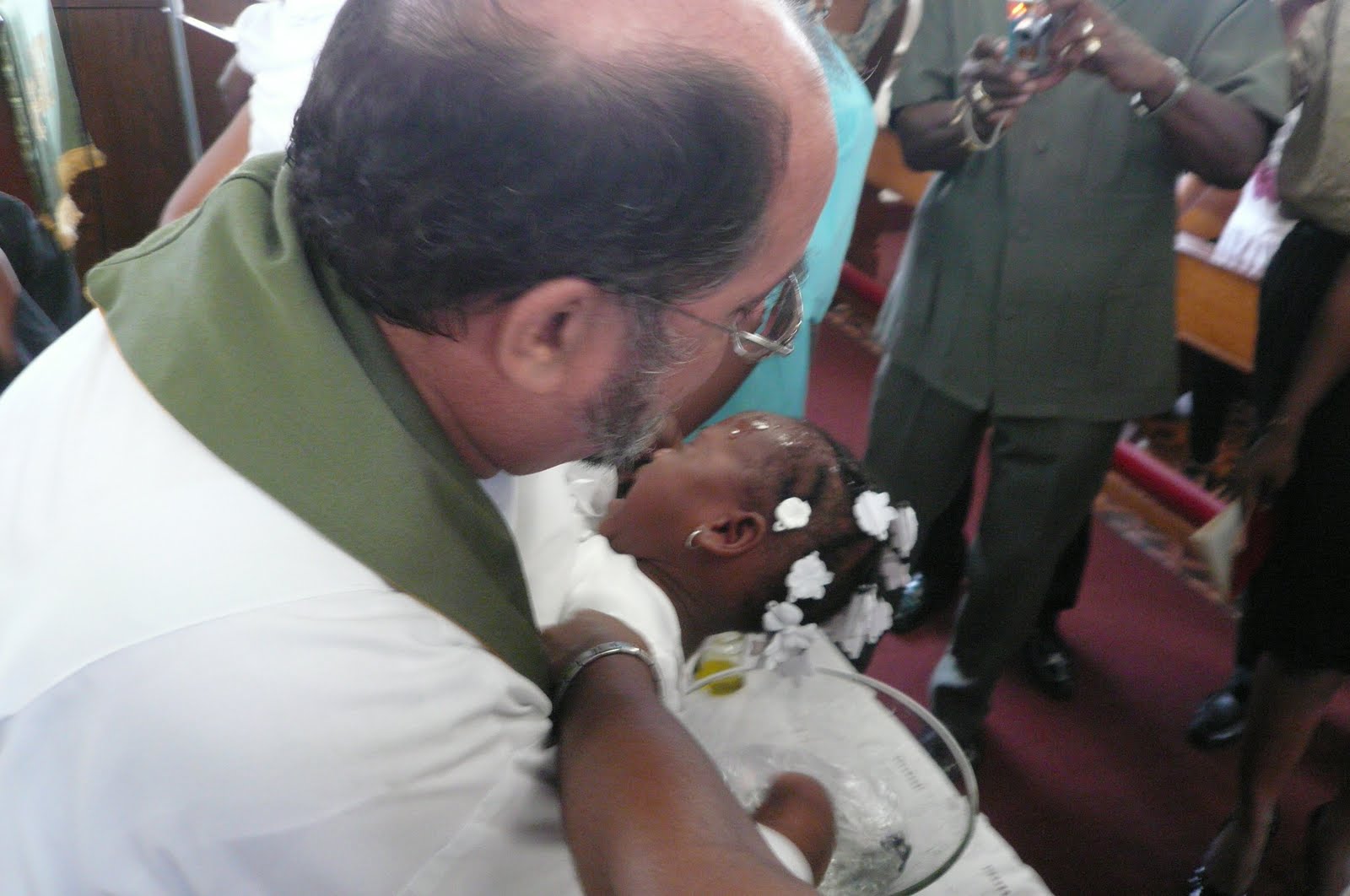
We also welcomed Darlene and her brother Darrell into the Family of Christ through the sacrament of Holy Baptism. Darlene did not like it when I splashed water on her head, but Darrell, who had been sleeping, opened his eyes while Padre Cáceres splashed him and then went right back to sleep!


To add to all the fun, the students of Grade 2 of Instituto Episcopal San Cristóbal and their parents all attended service, too. The Second graders gave a short presentation before the Offertory, including a short play. The kid playing Jesus was so quiet, even with the microphone, that I have no idea what he said. Then they all sang "Dios es Amor, la Bíblia lo Dice," along with all necessary hand gestures.


The kids all come up for a blessing before Communion is distributed. I like to get at eye level with them when I give them their blessing.


So, a very nice, lively Misa, all in all!

I See You!

Sign by Danasoft - Get Your Free Sign