Saturday, September 10, 2011

Feast of Alexander Crummell, Priest and Educator


Almighty and everlasting God, we thank you for your servant Alexander Crummell, whom you called to preach the Gospel to those who were far off and to those who were near. Raise up in this and every land evangelists and heralds of your kingdom, that your Church may proclaim the unsearchable riches of our Savior Jesus Christ, who lives and reigns with you and the Holy Spirit, one God, now and for ever. Amen.

Today is the feast of Alexander Crummell. He was an African-American and fought racism all of his life. He was born on March 3, 1819, in New York City. His father, Boston Crummell, was a former slave, while his mother, Charity Hicks, was a freeborn black woman. Both of his parents were very active in the Abolition Movement, and the first black newspaper, Freedom’s Journal, was published in their home. Their values guided him throughout his life. His father told him stories of his life back in Africa before he was captured, and these stories created a sense of unity with the people in Africa, as well as with those of African heritage in the Americas and throughout the world. He was also educated in Abolitionism by working with the American Anti-Slavery Society in New York during his youth. He was an intelligent person and one who wouldn’t take “no” for an answer. His tenacity and perseverance were important parts of his personality and were instrumental in his success.

Education was an important aspect of his success and drive, and his education started at home with private tutors and at the African Free School No. 2 in New York City. His secondary education was at Canal Street High School. Upon graduation from Canal Street, Alexander and his friend Henry Highland Garnet, another soon-to-be-famous Abolitionist, moved to New Hampshire to attend the Noyes Academy. The school was eventually destroyed by a lynch mob. According to W.E.B. Du Bois in his essay “Of Alexander Crummell” in his book The Souls of Black Folk, the “godly farmers hitched ninety yoke of oxen to the abolition schoolhouse and dragged it into the middle of the swamp.” Crummell returned to New York and enrolled at the Oneida Institute. It was at the Oneida Institute that he experienced his call to the priesthood, and he applied to the General Theological Seminary in New York. However, he was denied admission because of his race; his grades were good, he had references, but General Theological Seminary was not yet ready to be integrated. W.E.B. Du Bois’ account of Crummell’s rejection is as follows: They were not wicked men,—the problem of life is not the problem of the wicked,—they were calm, good men, Bishops of the Apostolic Church of God, and strove toward righteousness. They said slowly, “It is all very natural—it is even commendable; but the General Theological Seminary of the Episcopal Church cannot admit a Negro.” And when that thin, half-grotesque figure still haunted their doors, they put their hands kindly, half sorrowfully, on his shoulders, and said, “Now,—of course, we—we know how you feel about it; but you see it is impossible,—that is—well—it is premature. Sometime, we trust—sincerely trust—all such distinctions will fade away; but now the world is as it is.” Then, as now, there were some in the leadership of the Church who believed that any change in favor of the outcast was “premature” and that the outcast should simply be patient until “things change naturally.” Of course, change of that nature doesn’t occur naturally; one must push and fight for such change, and Alexander Crummell was exactly the kind of person who would push for change.

He moved to Boston and studied for ordination. He did his field work as a missionary in Rhode Island and was ordained a priest by the Bishop of Delaware in 1842. He eventually ended up in the city of Philadelphia with a letter of recommendation from his bishop to Bishop Onderdonk of Philadelphia. According to W.E.B. Du Bois, Bishop Onderdonk told Father Crummell that he would be received into the diocese on one condition: that he not attend Diocesan Convention, and that no black church ask for representation in the Diocesan Convention. There was no way a person like Alexander Crummell could accept such conditions and he gave up on the Episcopal Church and, in 1847, moved his family to England. He travelled throughout the country, giving sermons and lectures about slavery in the United States. He was interested in studying at the great Universities of England, either the University of Oxford or the University of Cambridge. The opportunity presented itself and he grabbed it. He enrolled at Queen’s College, Cambridge, and was awarded a degree in 1853. He left England for Liberia, where he served as a missionary-educator. He was a professor at Liberia College. He believed that slavery and oppression had corrupted the “warm, emotional and impulsive energy” of the African race, and he believed that Liberia could serve as a model Christian nation. He was an advocate of Pan-Africanism;
he believed that in order to achieve their potential, Africans from the U.S. and the West Indies needed to unite with their brothers and sisters in Africa. He travelled through the U.S. and West Indies, recruiting highly-skilled and educated people of African heritage to resettle in Africa, in Liberia. His Pan-Africanist views offended the white missionaries in Liberia, and those Liberians of mixed-race, and they made life difficult for Crummell. He found the racism of the missionaries and biracial Liberians to be intolerable and finally returned to the United States in 1873.

He moved to Washington, D.C. where he was appointed “missionary at large of the coloured people.” In Washington he was able to finally realize his vision of a black church which is a place of worship and social service. In 1880 he established St. Luke’s Church, the church which helped him realize his vision. He continued to fight racism in the church and society, and when the Southern Bishops of the Episcopal Church proposed that a separate missionary district be created for black churches, he organized a national convocation to fight the proposal, which became a model for such convocations throughout the Episcopal Church.

Crummell continued to work on behalf of Black nationalism, and to encourage self-help and economic development among people of African heritage. The last years of his life were spent setting up the American Negro Academy, an organisation of black intellectuals dedicated to the promotion of higher education, arts, and science as part of the struggle for racial equality. People of African ancestry from around the world came together as the American Negro Academy, and it was the first society of blacks to specifically promote the ideas which W.E.B. Du Bois
articulated as the “Talented Tenth” (W.E.B. Du Bois was a founding member with the Rev. Crummell). Members of the American Negro Academy had backgrounds
in Law, Religion, Medicine, Literature, and Community Activism. The goal of the organisation was to “lead and protect our people” and to be “a weapon to secure equality and destroy racism.”

While he was unable to realize all of his vision, his personal achievements are impressive, but even more impressive is the influence he exerted on the Pan-African movement and on Black nationalism. He influenced Marcus Garvey, W.E.B. Du Bois, and Paul Dunbar. His work for equality in the Episcopal Church eventually led to the creation of the Union of Black Episcopalians. His faith in God inspired his tenacity and his determination to continue against all odds, against institutional racism and even racism in Liberia. He worked to set up the institutions and encouragement which would guide the struggle for civil rights and racial equality in the United States of America and later the world. It is a struggle which continues and which his example inspires. I can't help but imagine the pride he would feel if he were here to see Barak Obama's candidacy, and the shock he would experience to realize that he is a candidate of the party which, during Crummell's lifetime, was the political party of Jim Crow and segregation, while the party influenced by Abolitionists has become the party of exclusion!

Alexander Crummell died the next year, in 1898. I will finish with the closing paragraphs of W.E.B. Du Bois’ essay: He sat one morning gazing toward the sea. He smiled and said, “The gate is rust on the hinges.” That night at star-rise a wind came moaning out of the west to blow the gate ajar, and then the soul I loved fled like a flame across the Seas, and in its seat sat Death.

I wonder where he is today? I wonder if in that dim world beyond, as he came gliding in, there rose on some wan throne a King, ---a dark and pierced Jew, who knows the writhings of the earthly damned, saying, as he laid those heart-wrung talents down, “Well done!” while round about the morning stars sat singing.

Friday, September 09, 2011

Friday Night Music o' Love!

The best riff of 1978, shared by Howard Devoto and Pete Shelley, but this is Magazine's version, which is the best, INHO!

Thursday, September 08, 2011

Feast of the Nativity of our Most Holy Lady the Θεοτοκoς


What is this sound of feasting that we hear?
Joachim and Anna mystically keep festival.
“O Adam and Eve,” they cry, “rejoice with us today:
For if by your transgressions you closed the gates of Paradise to those of old,
We have now been given a glorious fruit,
Mary the Child of God
Who opens its entrance to us all.”

Thy nativity, O Θεοτοκoς,
Has brought joy to all the world:
For from thee has shone fourth
The Sun of Righteousness, Christ our God.
He has loosed us from the curse and given the blessing:
He has vanquished death, and bestowed on us eternal life.

By thy holy nativity, O most pure Virgin,
Joachim and Anna were set free from the reproach of childlessness,
And Adam and Eve from the corruption of death.
Delivered from the guilt of sin,
Thy people keep the feast and sing:
“The barren woman bears the Θεοτοκoς,
the Sustainer of our life.”

Be renewed, O Adam, and be magnified, O Eve;
You prophets, dance with the apostles and the righteous;
Let there be common joy in the world
among angels and mortals
For the Θεοτοκoς is born today of
righteous Joachim and Anna.

Monday, September 05, 2011

Ayer en Parroquia San Cristóbal

We're up to fifty-six young people in the First Communion class which Padre Cáceres and the Escuela Dominical are leading. The classes will run through November, when the First Communion will take place. While this is not an Anglican practice, we're in a country where the Roman Catholic church is dominant and very much part of the culture, so, in true Christian manner, we've adapted!

Part of the program is to learn of all the different activities, groups, and guilds in the parish. All the students are expected to find a group or guild in which to participate. For the past two Sundays is appears that everyone wants to be in el Coro! We'll see how long that lasts.

Next week is trimester break, so no class, but the week after everything returns to what passes for normal at San Cristóbal and the la Misa a las 10:30 am will be full.


Saturday, September 03, 2011

IESC recycling ideas

Still catching up with my pictures. On my way to the music room a couple of weeks ago, I passed through the science dept. and the kids were displaying their use of recyclable items. Had to get pictures of their creativity.


This basket looks like it was made from pages of a magazine.


Cute dresses.


Friday, September 02, 2011

The Jam!

Sunday past at Parroquia San Cristóbal

I apologize for not blogging much lately. Real life can interfere with one's on-line life, except for them fast lil' snippys on FaceBook.

The church was packed for the 10:30 Misa en Español. Sunday past. Padre Cáceres has started a First Communion class which will run through November, and there are some fifty kids signed up. Classes take place after the Misa, and the kids and their parents all have to attend the services, so the place will be packed for several months. The students are encouraged to try all the different ministry opportunities such as choir, acolytes, ushers, and altar guild. Last Sunday I guess they all decided to be in the choir, which was a big surprise for the Lovely Mona.


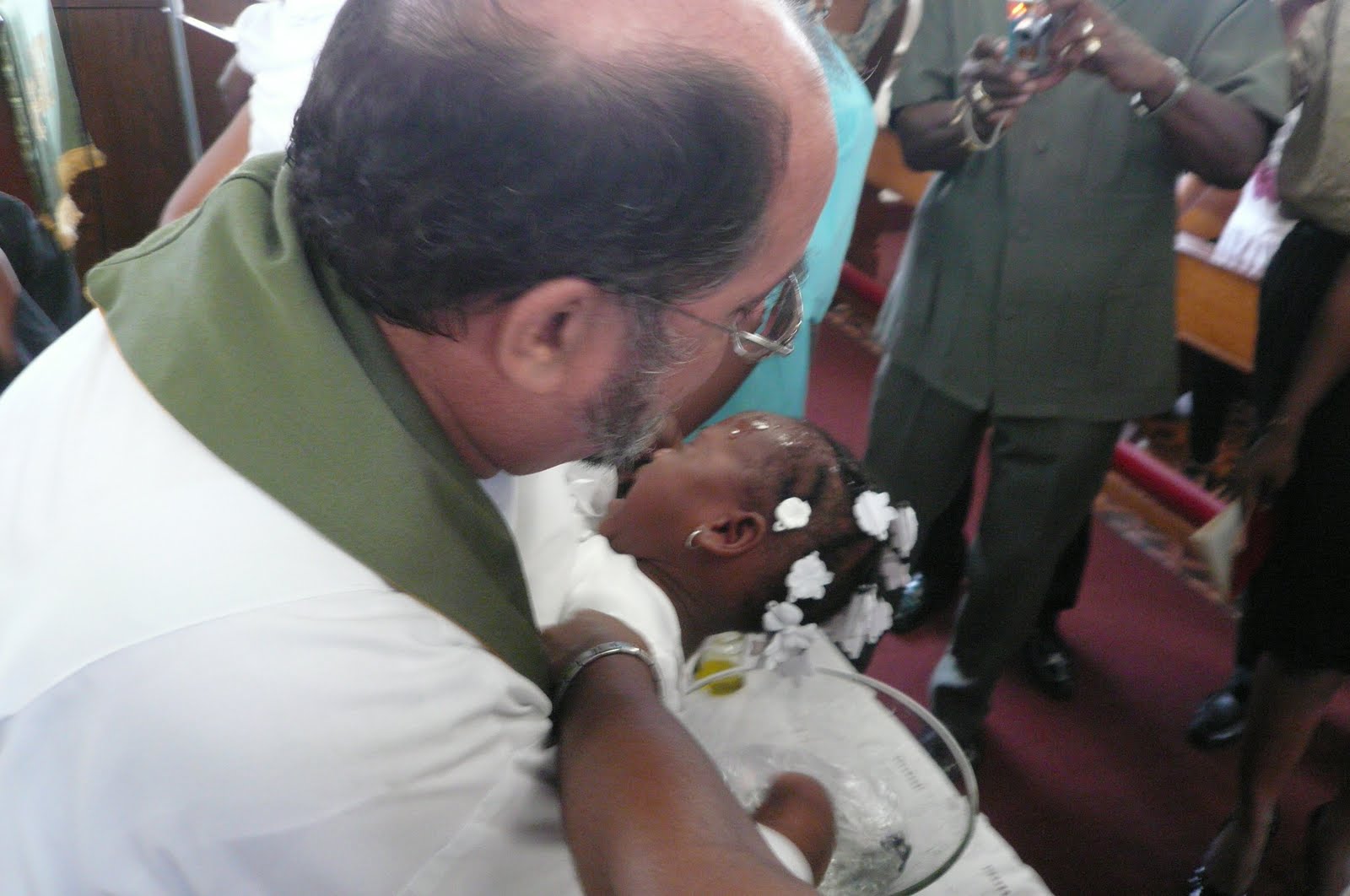
We also welcomed Darlene and her brother Darrell into the Family of Christ through the sacrament of Holy Baptism. Darlene did not like it when I splashed water on her head, but Darrell, who had been sleeping, opened his eyes while Padre Cáceres splashed him and then went right back to sleep!


To add to all the fun, the students of Grade 2 of Instituto Episcopal San Cristóbal and their parents all attended service, too. The Second graders gave a short presentation before the Offertory, including a short play. The kid playing Jesus was so quiet, even with the microphone, that I have no idea what he said. Then they all sang "Dios es Amor, la Bíblia lo Dice," along with all necessary hand gestures.


The kids all come up for a blessing before Communion is distributed. I like to get at eye level with them when I give them their blessing.


So, a very nice, lively Misa, all in all!

Sunday, August 28, 2011

Feast of St. Augustine, Bishop of Hippo

This is the same post as last year. It is a version of my sermon for Augustine's Feast Day. Even though many people don't like St. Augustine, he is one of my favorite saints.


There was a time when I didn’t like Augustine; I just knew him as the “inventor of the concept of original sin” so I figured he was really just a harsh man, but the more I studied his writings the more I was convinced that he was a compassionate man and one of the greatest of the early theologians. I was able to make connections between events in his own life and in mine, and this helped change my original impression of the man.

Augustine was born in the year 354 in the city of Thagaste in North Africa. His father was a pagan but his mother, Monnica, was a devout Christian. Her tenacity regarding her faith resulted in the eventual baptism of her husband, although most folks doubted it would ever happen. Monnica made sure that Augustine had a Christian education although it didn’t seem to take during his youth and young adulthood. He attended the University at Carthage, where he studied rhetoric and considered becoming a lawyer, but he soon became more interested in literary pursuits. While in Carthage, he pretty much abandoned any Christian faith he may have had and he took a mistress, to whom he was faithful for fifteen years; they had a son together. He was a bit of a truth seeker, investigating various philosophies and the different religious disciplines popular in that era; he even cast horoscopes for a while. His experience with astrology led to his later denouncement of the so-called science. At the age of nineteen he joined the Manichees, a religion formed around the teachings of Mani, a third-century Persian who called himself “The Apostle of Jesus Christ.” Mani taught a dualistic form of Christianity which he claimed to have received in direct revelation from God. Peter Brown, in his biography of Augustine, writes of this group: The Manichees were a small sect with a sinister reputation. They were illegal; later, they would be savagely persecuted. They had the aura of a secret society: in foreign cities, Manichees would lodge only with members of their own sect; their leaders would travel around a network of ‘cells’ scattered all over the Roman world. Pagans regarded them with horror, orthodox Christians with fear and hatred. They were the Bolsheviks of the fourth century... Augustine was a hearer of the Manichees, a member of the outer circle. The Manichees required a celibate and vegetarian lifestyle, and Augustine wasn’t quite ready to give up his mistress (I don’t know how he felt about meat), but as a hearer he could subscribe to their teachings without giving up everything just yet. The Manichees lived harsh lives, and this is often attractive to young, spiritually inclined persons. I spent some three years in a cult which I joined at the age of nineteen, and I was attracted to the group’s fierce spirituality, which seemed so much more authentic than the faith of my parents, and I think that Augustine was very much influenced in the same way. But there was a point when the teachings of Mani no longer appealed to him; he became disillusioned when he met one of the great Manichean teachers, Faustus. Faustus was unable to answer Augustine’s questions about the faith. When Augustine finally finished his courses at University, he left the Manichees and Carthage, and moved to Rome to teach. But he was so disgusted with the actions and attitudes of his students, whom he considered dishonest, that he left Rome and moved to Milan to be the Teacher of Rhetoric for the city. Now during his time in Carthage his mother Monnica never stopped praying that he would become a Christian. While in Milan he fell under the influence of Ambrose, the Bishop of Milan. Ambrose was a great preacher and orator, and Augustine enjoyed listening to him. Over time, the teachings of Ambrose began to take hold in Augustine, and one day, in a garden in Milan, Augustine, wrestling with the idea of giving up his present life and having that change of mind and heart which is repentance, sat under a fig tree, crying and wondering what to do. He heard the voice of a child from a nearby house chanting: “Pick up and read; pick up and read.” He picked up his friend’s Bible, opened it at random and read Romans 13:13-14: Let us live honorably in the day, not in riots and drunken parties, not in eroticism and indecencies, not in strife and rivalry, but put on the Lord Jesus Christ and make no provision for the flesh in its lusts. Augustine wrote about this event: I neither wished nor needed to read further. At once, with the last words of this sentence, it was as if a light of relief from all anxiety flooded into my heart. All the shadows of doubt were dispelled. And at that moment Augustine’s life changed. He was later baptized, and brought much joy to his mother’s heart. But he had many difficult decisions to make regarding the mother of his son, his teaching position, and his life in general. He left his position as Teacher of Rhetoric in Milan, and began to write essays on Christianity and philosophy and became a bit of a star in Christian circles.

Upon the death of his mother, he returned to Thagaste to take over the family estate. He and some friends decided to live lives of monastic discipline and start a monastery. Augustine went to the city of Hippo to see a friend and invite him to become part of their monastic community. The friend and Augustine attended services at the bishop's church; the bishop was preparing to retire and was speaking of the needs of the Church. The people in the church saw Augustine and grabbed him and wanted to make him Bishop, very much like what happened to Ambrose in Milan so many years before. The bishop, Valerius, managed to get Augustine to agree to become a priest in Hippo, and many witnesses thought that when Augustine burst into tears, he was sad because he wanted to be a bishop rather than a priest, but the truth was that Augustine didn’t want ordained ministry of any kind. He agreed to be a priest because he believed that this was God’s will, but it was not part of his desire.

There were two churches in North Africa in those days: the Catholic Church (not Roman Catholic) and the Party of Donatus, or the Donatists. During the Diocletian persecution the clergy were given a decision of whether to turn over the scriptures to the police and recant their faith or be executed. Some clergy gave up the scriptures and denounced their faith, but repented at the end of the persecution and returned to their churches. The Donatists believed that the sacraments administered by such clergy were not valid, since they had turned their backs on Christ and his Church. The Catholic church had reaccepted such clergy upon their repentance, but the Donatists refused them and fought with the Catholics. In many cities (much like today but unheard of in those days) there were two bishops: a Catholic bishop and a Donatist bishop, and the churches would fight and take over each other’s buildings, turning over the altars and trashing the place. Augustine preached against the Donatists, and when he became Bishop of Hippo he fought against them fiercely. Augustine taught that the bread and wine were a sacrament, not because of the worthiness of the priest, but because of an act of grace by God. The Donatists were harsh and unforgiving, but Augustine taught that God forgives all who repent, so the clergy who repented were still valid priests. Augustine became known as a great fighter of heresy. He waged war against the Donatists, the Manichees, and the Pelagians, because he desired that “no one be led astray.” Augustine wrote many volumes against the Donatist, the Manichees, and the Pelagians, and he also wrote many volumes on the scriptures and the Christian life. We could go on and on talking about his writings and many have, but we’ll move on to his final days. Augustine was a man who loved his books and his library. He spent the last three years of his life living in his library, editing and rewriting and organizing his papers. This library contained two-hundred thirty-two little books which made up ninety-three of his own works, not to mention many letters and copies of his sermons, which had been taken down by the stenographers of his admirers. He set about rezeroing his many works and produced Retractiones, a catalogue of titles, arranged in chronological order, with a brief note of the content of the work, along with Augustine’s comments. May of the remarks are self-criticisms, but quite often they were also attempts to explain himself. At the same time that he was organizing this library, he was also involved in a debate by correspondence with Bishop Julian of Eclanum, a defender of Pelagius. Augustine would spend his nights reorganizing his works and writing comments, and his days dictating letters and fighting with Julian. He was depressed to see the decline of Rome and its civilization and the military attacks of the Vandals which threatened Roman Africa. The Vandals were Christians, but Arian Christians, another group of heretics destroying the world in which Augustine lived.

In August of the year 430, Augustine came down with a fever. He knew he would die, and he wanted to die alone. His first biographer, Possidius, described Augustine’s attitude: He had told his followers that even praiseworthy Christians and bishops, though baptized, should still not leave this life without having performed due and exacting penance. This is what he did with his own last illness: for he had ordered the four psalms of David that deal with penance to be copied out. From his sickbed he could see these sheets of paper every day, hanging on his walls, and would read them, crying constantly and deeply. And, lest his attention be distracted from this in any way, almost ten days before his death, he asked us that none should come in to see him, except at those hours when the doctors would come to examine him or his meals were brought. This was duly observed: and so he had all that stretch of time to pray...

Augustine died and was buried on August 28, 430. A year later Hippo was evacuated and partially burnt, but his library escaped the destruction, and that is why we know so much about him today. His experience in rhetoric and logic, and his studies as a Neo-Platonist, along with his powerful intellect, made him a most worthy adversary of Greek philosophy, and his many written works are still studied by theologians today. His two books The Confessions and The City of God are considered classics. Yet I think it his understanding of God’s love and grace, and his desire that no one be led astray that made Augustine the mighty warrior for Christ that he was. The faith which Augustine received and defended was strengthened by his gifts, and we, the Body of Christ, are very much blessed because of his great faith. The Manichees, the Donatists, and the Pelagians all believed that humans had the power to live perfect lives or that humans could stop the work of the Holy Spirit, but Augustine taught us that “man is but a little piece of God’s creation” and that God so loved this piece of creation that God would forgive us all our sins. Augustine believed strongly in God’s grace and love. May we, too, experience God’s love and grace.

Lord God, the light of the minds that know you, the life of the souls that love you, and the strength of the hearts that serve you: Help us, following the example of your servant Augustine of Hippo, so to know you that we may truly love you, and so to love you that we may fully serve you, whom to serve is perfect freedom; through Jesus Christ our Lord, who lives and reigns with you and the Holy Spirit, one God, now and for ever. Amen.

Saturday, August 27, 2011

More IESC Photos

We're going back to July 25 with this group of photos. IESC celebrated their 46th anniversary with a couple of masses. First was the mass for the primary grades. We had our mass shortly afterwards.

The band played Amazing Grace for the offertory and the school anthem when the service was over.


Bringing up the elements

Communion


Padre Cáceres, Padre Austin, and Carlito Austin

This group sang the hymns for the service. They sang some great Panamanian music. Wish I could find a recording of the style.

I See You!

Sign by Danasoft - Get Your Free Sign