Sunday, April 13, 2014
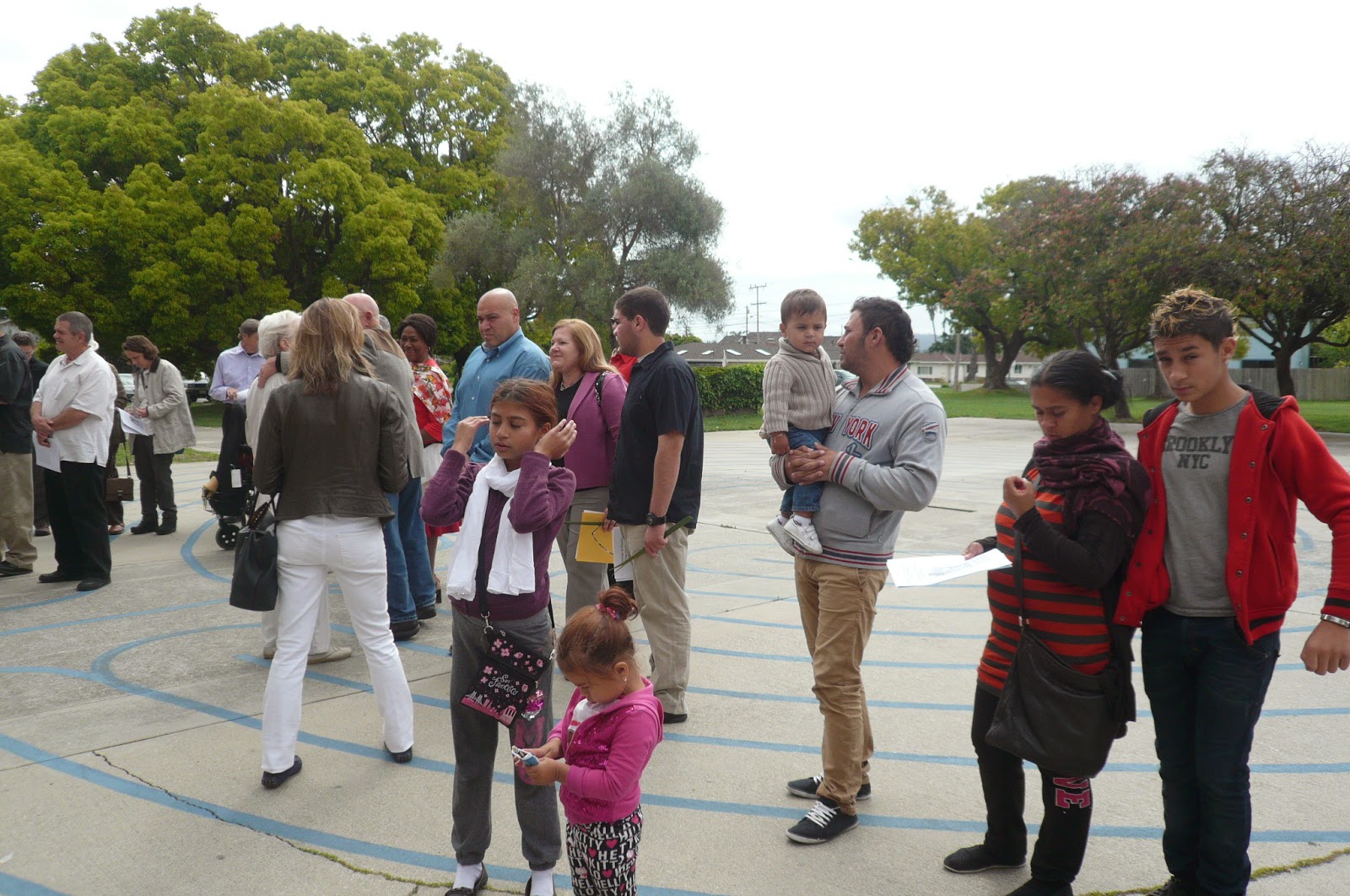
Palm Sunday at the Episcopal Churches of All Saints' and Cristo Rey in Watsonville, California.
Our Bishop, the Rt. Rev. Mary Gray-Reeves visited us for Palm Sunday. We had a bilingual service, ¡and the Passion was bilingual, también! AND, as usual, we had an incredible lunch afterwards. A great time was had by all.


Tuesday, March 25, 2014
The Feast of the Annunciation of our Lord

Today is the Feast of the Annunciation of Our Lord, the commemoration of the visit of the Archangel Gabriel to a young Jewish girl in Palestine some two thousand years ago. This feast has been celebrated since the fifth century, and it is one of the few feasts which are important enough that the fast of Lent is actually suspended for the day. Some see this feast as Mariological, that is, that it has to do primarily with the Blessed Virgin, but I see it as Christological, I believe that it has more to do with the Christ, the Incarnation.
The reading we heard this morning from the Hebrew scriptures is a very interesting reading, as it can be understood on two levels, and both have to do with prophecy. We can read the meaning of this text in its original historical situation which is described in the second Book of Kings. The nation of Syria had entered into an alliance with the northern kingdom of Israel against the southern kingdom of Judah, of which Ahaz was king. Both Syria and Israel had laid siege to the city of Jerusalem. The prophet Isaiah offered Ahaz a sign that everything would eventually work out and be successful, but Ahaz refused the sign, probably because he didn't want Isaiah's advice. Isaiah was a prophet who always spoke the word given to him by God' he didn't care whether Ahaz wanted to hear it or not. The sign Isaiah gave Ahaz was: A young woman will conceive and bear a son, and shall call his name Emmanuel. In this context, it is probable that the young woman was the wife of Ahaz, and the son to be born is Hezekiah, the future king of Judah. The sign, then, concerned the continuation of the dynasty of David, a sign that God was still with God's people.

The second meaning is that of Matthew and is the meaning which we, as Christians, recognize. We read this as a prophecy of the coming of the Messiah, and we see the young woman as Mary, and the son as Jesus. When the author of Matthew's gospel quoted Isaiah's prophecy, he was not using the actual Hebrew text but using a translation we call the Septuagint which is a translation from the original Hebrew into Greek, which is the language of the Christian scriptures or New Testament. In the Septuagint the word for young woman was translated as παρθενους, which means "virgin." Now, it's quite probable that Isaiah was only thinking of the immediate future when he made his prediction to Ahaz, but since he as a prophet, and the Spirit of God was upon him, the Holy Spirit was speaking through him and this prophecy did have to do with the birth of Hezekiah but also had to do with the birth of the Incarnation. The genealogies of both Matthew and Luke serve to tell us that the birth of Jesus was also a continuation of the Davidic dynasty, and Jesus truly was Emmanuel, "God with us." The Holy Spirit, speaking through the prophet Isaiah, was giving hope to Ahaz and hope to the entire world.
The reading from the Gospel of Luke is the story of the Annunciation, and it is a story that we usually only hear during Advent, and people outside of the Liturgical tradition only think of this story during Christmas. The Bible contains several annunciation stories: there are annunciation stories about the birth of Isaac, about the birth of Samson, the birth of Samuel, and, of course, the birth of John the Baptizer. The purpose of an annunciation story is to acquaint the reader or those listening to the story with the role that the person about to be born will play in salvation history. The purpose is to give us a foreshadowing, in a way, of what will happen, of how important this person's life will be; it is not to serve as an accurate historical narrative. In the other annunciation stories I mentioned, the situation was that a child was to be born to a couple who were either barren and unable to have children, or, in the case of Abram and Sara, a couple who were well past child-bearing age, so the angel was announcing a miraculous birth. But the situation in today's story is quite different: this annunciation is to a young woman of child-bearing age, but she is a woman without a husband, which, as we all know, does not prevent one from having a child. The emphasis in this story is not on a miraculous birth, but on the creative act of the Holy Spirit in bringing about the conception in the womb of this young girl so that the Incarnation, God in Flesh, could come and live among us, so that Emmanuel, God-with-us, could be born in a simple stable with beasts of burden. The Archangel Gabriel came to this young, frightened girl, and informed her that she had been chosen above all others to be the Θεοτοκυς, the God-bearer. Gabriel told her that she would become pregnant, that she would have a son, that his name would be Jesus, and that he would be called Holy and the Son of God. When Mary asked how this could be since she did not have a husband, Gabriel explained the process to her, and also told her that although this may sound strange, her cousin Elizabeth was with child because with God nothing is impossible. And Mary, the one we call Blessed above all women, said, "You see before you the Lord's servant; let it happen to me as you have said." And with her agreement, and with her obedience to God's will, the salvation of the world was able to take place. It is said that "God made us without us, God redeemed us without us, but God cannot save us without us." Mary represented all of humanity when she said "yes" to God's plan, and we have been saved because a human being allowed God to dwell in her womb for nine months.

Mary answered "yes" to God's call, just as Abraham had answered "yes" to God's call. When Abraham answered God's call, he became the father of a mighty nation, the nation of Israel. When Mary answered God's call, she became the mother of the faithful, of God's people, the Λαος, the People of God' she became the mother of the New Israel. Her response to Gabriel, "You see before you the Lord's servant; let it happen to me as you have said," expresses the same faith as that expressed in the prayer her son, Jesus, taught us to say: Your will be done on earth as in heaven. The Annunciation is an event outside of history, because it is the direct intervention of God in human affairs, it is the actual insertion of God into human affairs, because God took on a human body and lived and laughed and ate and drank and slept and woke and experienced all the joys and trials which make up this life, this human existence.
The Feast of the Annunciation takes place on March 25th because it is supposed to be exactly nine months before the birth of Jesus. You mothers know that it is actually quite rare that someone is born exactly nine months after conception; some babies are early and some are late, and it is quite probable that Jesus was not born on December 25. St. Clement of Alexandria was sure that Jesus was born on May 20. But I think that it is appropriate that the Feast of the Annunciation is celebrated during Lent, because the Lenten season points towards the purpose of the Incarnation: to live as one of us, to be arrested and executed, to be buried and then on the third day be resurrected so that death would be conquered, that humanity would be redeemed and given the gift of eternal life. Lent points us towards the arrest, crucifixion and resurrection of Jesus, and the Annunciation points us towards the birth by which the Incarnation came to live among us.
Today we celebrate the Archangel's message to a young girl. Today we celebrate the young girl's obedience to God's will. Today we celebrate the life which told us of the Good News of forgiveness of sins and the coming of God's Reign.

Pour your grace into our hearts, O Lord, that we who have known the incarnation of your Son Jesus Christ, announced by an angel to the Virgin Mary, may by his cross and passion be brought to the glory of his resurrection; who lives and reigns with you, in the unity of the Holy Spirit, one God, now and for ever Amen.
Wednesday, March 19, 2014
Feast of St. Joseph
As is usually the situation with the members of Jesus' family, we know very little about Joseph. The gospel texts tell us that he was a carpenter, that he was a descendant of David the king, and we know that he had to go to Bethlehem for the census. We know that he was betrothed to Mary and wasn't too sure about things when he learned that she was with child, and we also know that he was still around when Jesus was twelve years old. Everything else is a guess and is usually something someone made up for a theological or dogmatic reason.
One thing we know about Joseph is that he was obedient; even when he had his doubts about the marriage and his young bride, when angels would appear to him in his dreams and give him instructions, he would follow them. He married Mary even though she was pregnant, and he took his young wife and baby son to Egypt when instructed by an angel in order to save them from the wrath of Herod. We know that Joseph was a devout Jew and that he brought his family to Jerusalem to sacrifice at the Temple. These are the only stories we have from the Bible. But many traditions sprang up involving Joseph over the centuries. There is a tradition that Joseph was an elderly man when he wed Mary. This tradition was probably invented as a means of preventing some from thinking that Joseph was the biological father of Jesus. If Joseph was an elderly man then he probably had lost all interest in sex by the time he and Mary were wed, so he couldn't possibly be Jesus' biological father; plus Mary could remain ever-virgin! There is another tradition that Joseph was a widower and that his marriage to the Blessed Virgin Mary was his second marriage. This idea may have been developed as a means of explaining all those brothers and sisters of Jesus; if Mary was ever-virgin, those other kids must be step-children. Personally, I don't accept those stories; I thin that Joseph was probably in his twenties when he married Mary, and I think that they had at least four sons together and several daughters, too. He isn't mentioned in the texts after the visit of Jesus to his home town because he was no longer important to the story. The Gospels are not histories in the same sense as a book about the building of the Canal is a history; the purpose of the Gospels is to tell the Good News and they are theological documents serving a theological purpose, not an accurate history as we modern people expect in a historic document.

Today's Gospel reading gives us the only story from a canonical source on the childhood of Jesus. There are several non-canonical sources on his childhood and we call them infancy gospels. This story from Luke's gospel is the only story as such in the Bible. In this story Jesus is very precocious, telling his family that he must be about his Father's business. When I head this story as a child, I always liked it because the child Jesus showed-up all the adults, but as a father I have a lot of sympathy for Joseph and Mary, as I know what it is like to raise a precocious child. Raising precocious children can be difficult, but imagine how difficult it must have been to raise the Incarnation! In this story Joseph and Mary noticed that Jesus was missing, they've gone all the way back to Jerusalem to find him sitting in the Temple teaching the Scribes and Pharisees and Teachers, and he doesn't even feel bad about worrying his parents. When his mother scolds him, he says, "Why were you searching for me? Don't you know that I must be in my Father's house?" In the infancy gospels little Jesus turns children who make fun of him into goats and he even raises a child from the dead to clear himself from the accusation that he had pushed the boy off a tower. Raising little Jesus must have been quite a task! Actually, I think that Jesus was probably more like all the other children in the neighborhood; I doubt that he was turning other children into goats and I'm sure he didn't spend his time doing magic tricks. He probably helped his father and learned about carpentry, and he probably helped his mother take care of his younger brothers and sisters. I'm sure that the family of Joseph and Mary and Jesus and his siblings was as normal as all the other families living in Nazareth, a rather typical Galilean family.
Joseph is very important because he gave Jesus and James and Judas and the other children the fatherly influence that they needed to grow up to be the adults God wanted them to be. Joseph must have been a good, loving father, because the image of the father in Jesus' teachings is that of a loving, caring person. There are many people in the world who do not have good fathers; their fathers are uncaring and abusive, and this affects a person's perception of a father and it makes the name "Father" for God a problem, because when these people hear the word "father," they experience fear or loathing. But Jesus understood the word "father" to be a positive word. For Jesus the image of a father is that of a loving, caring, welcoming person and I'm sure that this image had a lot to do with his experience of his earthly father, Joseph.

Joseph was willing to take Mary as his wife even though her condition could bring scandal upon his name. Joseph was willing to pick-up and head for Egypt for a few years in order to protect his wife and infant son. He returned to Galilee, to Nazareth, and there he raised a family and worked as a carpenter and was a model of fatherhood for Jesus and his brothers and sisters. Joseph is a model of dedication and obedience; obedience to God and dedication to his family, and that is why we honor his memory today.
O God, who from the family of your servant David raised up Joseph to be the guardian of your incarnate Son and the spouse of his virgin mother: Give us grace to imitate his uprightness of life and his obedience to your commands; through Jesus Christ our Lord, who lives and reigns with you and the Holy Spirit, one God, for ever and ever. Amen.
Monday, March 17, 2014
Feast of Patrick, Missionary to Ireland

Almighty God, in your providence you chose your servant Patrick to be the apostle of the Irish people, to bring those who were wandering in darkness and error to the true light and knowledge of you: Grant us so to walk in that light that we may come at last to the light of everlasting life; through Jesus Christ our Lord, who lives and reigns with you and the Holy Spirit, one God, for ever and ever. Amen.
Today is the Feast of St. Patrick, which is a huge celebration in the U.S.A., with parades and speeches and people wearing green and, from what I remember from elementary school, lots of pinching. I think the celebration of St. Patrick's Day has more to do with the pride of those of Irish heritage in the land of their ancestors than with the actual St. Patrick; leprechauns and green beer and getting plastered have nothing to do with the saint, and such celebrations do not take place in Ireland. Today we are going to remember Patrick as a missionary and bishop, and as the man who helped spread Christianity throughout Ireland.
Patrick did not bring Christianity to Ireland; there were Christians in Ireland in the fourth century, probably as a result of contact between the British, who had first heard the Gospel with the arrival of missionaries in the second century. The Celtic Church was different from the Roman Church; they kept a different date for Easter and their spirituality was different than that of the Western or Roman church.
Patricus was probably born in the year 390 in Britain. Patrick's family were Christians; his grandfather was a priest and his father was a deacon. His father, Calpornius, was also an important official in the Roman imperial government in Britain. Yet even though he came from a Christian family, Patrick, like many young people, didn't really concern himself with the faith or with his education. He regretted his lack of education for the rest of his life. When he was sixteen years of age, his village, Bannavem Taburniae, was raided by Irish pirates or slave-raiders, and he and many other people were captured and taken away. Here is how he tells the story in his Confession: I was then about sixteen years of age. I did not know the true God. I was taken into captivity to Ireland with many thousands of people---and deservedly so, because we turned away from God and did not keep His commandments, and did not obey our priests, who used to remind us of our salvation. And the Lord brought over us the wrath of his anger and scattered us among many nations, even unto the utmost part of the earth, where now my littleness is placed among strangers.
And there the Lord opened the sense of my unbelief that I might at last remember my sins and be converted with all my heart to the Lord my God, who had regard for my abjection, and mercy on my youth and ignorance, and watched over me before I knew Him, and before I was able to distinguish between good and evil, and guarded me, and comforted me as would a father his son.

Patrick was forced to work as a shepherd, and he spent a lot of his time in repentance and prayer. He also had a vision which told him that he would return home: But after I came to Ireland---everyday I had to tend sheep, and many times a day I prayed---the love of God and His fear came to me more and more, and my faith was strengthened. And my spirit was moved so that in a single day I would say as many as a hundred prayers, and almost as many in the night, and this even when I was staying in the woods and on the mountains; and I used to get up for prayer before daylight, through snow, through frost, through rain, and I felt no harm, and there was no sloth in me---as now I see, because the spirit within me was then fervent. And there one night I heard in my sleep a voice saying to me: "It is well that you fast, soon you will go to your own country." And again, after a short while, I heard a voice saying to me: "See, your ship is ready." And it was not near, but at a distance of perhaps two hundred miles, and I had never been there, nor did I know a living soul there; and then I took to flight, and I left the man whith whom I had stayed for six years. And I went in the strength of God who directed my way to my good, and I feared nothing until I came to that ship.
When he first came and asked the captain for work on the ship, the captain was angry and said, "There is no room and it is no use for you to ask to go along with us." Patrick, discouraged, turned away and started walking down the path. He was praying that God would guide him safely back to his hut, but before he even ended his prayer he heard a sailor calling: "Come, hurry, we shall take you on in good faith; make friends with us in whatever way you like." Patrick thanked God and hoped to bring them all to Christ, as they were all Pagans. Three days later they arrived on the coast of Britain. They left the boat and began traveling by foot. Patrick writes: . . . for twenty-eight days we traveled through deserted country. And they lacked food, and hunger overcame them; and the next day the captain said to me, "Tell me, Christian, you say that your God is great and all-powerful; why, then, do you not pray for us? As you can see, we are suffering from hunger; it is unlikely indeed that we shall ever see a human being again." I said to them full of confidence: "Be truly converted with all your heart to the Lord my God, because nothing is impossible for Him, that this day He may send you food on your way until you be satisfied; for He has abundance everywhere." And, with the help of God, so it came to pass: suddenly a herd of pigs appeared on the road before our eyes, and they killed many of them; and there they stopped for two nights and fully recovered their strength, and their hounds received their fill for many of them had grown weak and were half-dead along the way. And from that day they had plenty of food.

That night Patrick had a dream that Satan was holding him down, and he called out to God and was saved from Satan's grasp, and he realized from that moment on that the Spirit of God would speak and work through him. He eventually left this gang and returned to his family. He also as educated as a Christian and took on Holy Orders, being ordained deacon, priest, and eventually, bishop. All during this time back home he had visions calling him back to the land of his captivity: And there I saw in the night the vision of a man, whose name was Victoricus, coming as it were from Ireland, with countless letters. And he gave me one of them, and I read the opening words of the letter, which were "The voice of the Irish;" and as I read the beginning of the letter I thought that at the same moment I heard their voice---they were those beside the Wood of Covlut, with is near the Western Sea---and thus did they cry out as with one mouth: "We ask thee, boy, come and walk among us once more." And I was quite broken in heart, and could read no further, and so I woke up. Thanks be to God, after many years the Lord gave to them according to their cry. And another night---whether within me or beside me, I know not, God knows---they called me most unmistakably with words which I heard but could not understand, except that at the end of the prayer He spoke thus: "He that has laid down His life for thee, it is He that speaketh in thee;" and so I awoke full of joy.
Patrick decided to answer this call and return to Ireland, but he was opposed by other bishops and he also suffered a serious illness. Patrick decided that this was for his own good and that he was being purged by the Lord. He finally returned to Ireland in the year 432, arriving not far from the area where he had been a shepherd. He set-up a church in Armagh, which served as his head-quarters, and he traveled throughout Ireland, preaching and baptizing. He usually preached to the chiefs of clans and with their conversion the entire tribe would convert. He also Christianized the old religion, building churches over former Druid holy sites, carving crosses on druidic pillars, and putting sacred wells and springs under the protection of Christian Saints. His conversion of the three High Kings of Ireland put Ireland on the road to becoming a Christian nation. He educated the sons of the chiefs and kings, he established monasteries throughout the land, he ordained clergy and he instituted monks and nuns. The monasteries of Ireland became incredible powerhouses of education and spirituality. He stayed in Ireland for the rest of his life, and probably died around the year 461. We don't know the date of his death, but the celebration of March 17 dates to the seventh century. I doubt that he chased the snakes from Ireland, or that he used shamrocks to explain the concept of the Trinity, and most of the other miracles attributed to him were invented over the centuries. We do know that he was a faithful bishop and loved the people of Ireland.
I will close with the ending paragraphs of Patrick's Confession: Wherfore may God never permit it to happen to me that I should lose His people with He purchases in the utmost parts of the world. I pray to God to give me perseverance and to deign that I be a faithful witness to Him to the end of my life for my God.
And if ever I have done any good for my God whom I love, I beg Him to grant me that I may shed my blood with those exiles and captives for His name, even though I should be denied a grave, or my body be woefully torn to pieces limb by limb by hounds or wild beasts, or the fowls of the air devour it. I am firmly convinced that if this should happen to me, I would have gained my soul together with my body, because on that day without doubt we shall rise in the brightness of the sun, that is, in the glory of Christ jesus our Redeemer, as sons of the living God and joint heirs with Christ, to be made conformable to His image; for of Him, and by Him, and in Him we shall reign.
For His sun which we see rises daily for us because He commands so, but it will never reign, nor will its splendor last; what is more, those wretches who adore it will be miserably punished. Not so we, who believe in, and worship, the True Sun---Christ---who will never perish, nor will he who doeth His will; but he will abide for ever as Christ abideth for ever, who reigns with God the Father Almighty and the Holy Spirit before time, and now, and in all eternity.
Behold, again and again would I set forth the words of my confession. I testify in truth and in joy of heart before God and His holy angels that I never had any reason except the Gospel and its promises why I should ever return to the people from whom once before I barely escaped.
I pray those who believe and fear God, whosoever deigns to look at or receive this writing which Patrick, a sinner, unlearned, has composed in Ireland, that no one should ever say that it was my ignorance if I did or showed forth anything however small according to God's good pleasure; but let this be your conclusion and let it so be thought, that---as is the perfect truth---it was the gift of God. This is my confession before I die.
Patrick was creative in his evangelism, he understood that incorporating what was familiar would do much more to further the message of the Gospel rather than trying to force the Irish into some concept of The Faith Once Delivered. He understood the importance of education and the intellect in Christianity. He was faithful to God and faithful to the Irish. He is an example of a missionary who loved and served the people to whom he had been sent. And that is why we remember him today.
Friday, February 14, 2014
Feast of Cyril and Methodius, Missionaries to the Slavs

Today is St. Valentine's Day, but no one is really sure who this St. Valentine was. He may have been a Roman priest martyred during the reign of the Emperor Claudius in the mid third century, or he may have been the bishop of Terni, who was taken to Rome and martyred and whose remains were returned to Terni. The feast of St. Valentinus was once on the Roman calendar but he was dropped quite a while back, and now his day is more of a "Hallmark Holiday" a holiday for selling greeting cards, flowers, and chocolates.
Today is also the Feast of Saints Cyril and Methodius, two very important saints. Cyril and Methodius were brothers and lived in Thessalonica, a town where Christians were gathering very early in the history of the Church. Methodius was born around the year 815 and his brother Constantine was born around the year 826. Constantine studied philosophy and later became a monk, taking on the name of Cyril. As a philosophy student, Cyril also studied languages and was well-versed in Hebrew, Arabic, and even the Samaritan dialect. In the year 860, Photius, the patriarch of Constantinople selected Cyril and Methodius as the first missionaries to the Slavs. He chose them not only because Cyril was good with languages, but because as children both brothers spent a lot of time around the Slavs who lived in Thessalonica; they learned the Slavic language and were fluent in that language. They were the natural choice to be missionaries to the Slavs. Their first missionary trip in 860 was to the Khazars who lived north of the Caucasus region, but it was unsuccessful and the Khazars actually ended up accepting Judaism instead of Christianity. In the year 863, Rostislav, prince of Moravia (which is the area we now call the Czech Republic), requested Christian missionaries be sent. He had one requirement: that the missionaries be able to preach to the people in their own language and must do services in Slavonic, which meant that they needed Bibles and service books in Slavonic. So, before they even left for Moravia, the brothers started translating the Bible into Slavonic. There was not actual Slavonic alphabet so they had to invent one with which they would write their translations of the Bible and prayer books. The alphabet invented by St. Cyril is called Glagolithic and his followers invented another alphabet called Cyrillic which is the alphabet used in Russia and the former Eastern Block nations to this day. They translated the Bible into the dialect they had learned as boys, a Macedonian dialect of slavonic spoken around Thessalonica, an this language is now called Church Slavonic, and it is the liturgical language of the Russian Orthodox Church and the Slavonic Orthodox Churches. This is very important, because the Slavs were one of the few peoples who heard the gospel read in their own language instead of Greek or Latin, the major languages of the Church at that time. The Roman church always insisted that everything be done in Latin, but the Eastern church felt that it was important that services and readings be done in the vernacular of the people, the same concept which is accepted in the Anglican Communion. Cyril and Methodius ran into some trouble in Moravia and in Bulgaria; the Church in the West had sent German missionaries and they did not like the Greek Orthodox monks working in their area. The brothers were doing services in the language of the people while the Germans did everything in Latin; the brothers recited the Nicene Creed in its Eastern form without the filioque. In order to end German interference with the mission, Cyril asked for the protection of the Pope as he really didn't get involved in the East-West arguments and the Church was still united at that time; Cyril just wanted to continue working in Slavonic. The brothers traveled to Rome in 868 to speak to Pope Hadrian II, and he received them favorably and gave full support to their mission, allowing them to work in Slavonic, and even approved their translations of the Bible and service books. Unfortunately, Cyril died in Rome in 869, and when Methodius returned to Moravia, the Germans ignored the Pope's decision and obstructed him in every way; they even put Methodius in prison for a year!
When Methodius died in the year 885, the Germans ran his followers out of the country and even sold some of them into slavery (fine Christian people!). The Slavonic church lasted there for another two hundred years but then vanished; it seemed as if the mission of Cyril and Methodius had failed. but while their mission died in Moravia their translations moved in to Bulgaria, Serbia, and Russia, and Church Slavonic is the liturgical language of those areas. The Church grew and spread throughout that area and even lasted through fifty years of Communist oppression.
Some of the issues that Cyril and Methodius dealt with are still important today and are even important to us here in Panama. The issue of language is a very important issue here. I think that what saints Cyril and Methodius taught us is that it is important that people hear the gospel and worship in the language with which they are familiar, whether that language be English, Español, or Slavonic. When people hear the gospel in their own language the church takes root and grows. Cyril knew that it was important that the peoples of the Caucasus hear the Word in their own words and he was willing to go to those who spoke Latin to get the support he needed, because he knew that the Church is large enough to include everybody, whether they speak Español, English, Nippon-go, Hungarian, Greek or Slavonic, God hears us no matter what language we speak. What is important is that we remember that we are One Body, we are united as one body in Christ. One of the oldest Eucharistic prayers we have is in the Didache and it says "as this grain was once scattered over the hills and was brought together as one loaf of bread, so may your Church be brought together from the ends of the earth into your Kingdom." Let us take the example of saints Cyril and Methodius to heart realizing that the Church is One Body in Christ.
Almighty and everlasting God, by the power of the Holy Spirit you moved your servant Cyril and his brother Methodius to bring the light of the Gospel to a hostile and divided people: Overcome all bitterness and strife among us by the love of Christ, and make us one united family under the banner of the Prince of Peace; who lives and reigns with you and the Holy Spirit, one God, now and for ever. Amen.
Saturday, February 01, 2014
Feast of St. Brigid (Bride) of Cille-Dara
This is my St. Brigid's feast sermon

Today is the feast of St. Brigid, who is also called St. Bride. Next to St. Patrick, she is the most beloved of Irish saints. She is known as one who was generous, handsome, and brave. Born in Fauchart around the year 452, she may have actually met St. Patrick as a young girl. She was the daughter of a wealthy chief name Dubhtach and his slave Brocessa. According to the miracle-filled "Life of St. Brigid" written in the eighth century, she was baptized by three angels who also anointed her with oil. When Brigid was very young her mother was sold to a Druid, so she actually grew-up in a Druid household. She, however, was a Christian and remained true to her faith throughout her stay in that pagan household. A few years later she was returned to her father's household. She remained a slave but it seems that she had a special standing in the household. She became known for her generosity, especially her generosity with her father's possessions. Nothing was safe; she would give anything she owned away and once she ran out of things she would give away the belongings of the household. Once while watching a flock of sheep a poor young man came up to her and asked for some alms. She gave him one of the flock without question. He, however, having heard of her generosity, came back seven times that day, receiving a sheep each time. It seems that everyone in the village knew what was going on, but they were all shocked when, at the end of the day, Brigid returned with the flock and not one sheep was missing!
She was very beautiful and many young men approached her father asking for her hand, but Brigid told him that she didn't want to be married, she wanted to dedicate herself to the Lord. According to the Life of St. Brigid she prayed that God would disfigure her so that she would no longer be attractive to all the young men. While she was praying her eyeball melted (ew!), making her no longer attractive to the young men (or anyone else for that matter!). Her father was so angry at her that he decided to sell her to the King of Leinster. While her father was talking to the king, trying to set up a deal, she gave her father's sword to a poor person to sell for food. The king asked her why she gave away her father's sword, she answered, "I gave it to Christ, and if God asked me for all your wealth and the wealth of my father I would give it to the poor to please God." The king looked at her father and said, "Your daughter is of far too much worth for me to buy and of even greater worth to be sold by you!" He sent Brigid and her father on their way. Her father finally allowed her to become a nun, and she received the veil from Bishop Macaile of Westmeath. In the year 470 she gathered seven young women with her and started a convent at at Cille-Dara, which means "Church of the Oak" in Gaelic. It is now known as Kildare. She wanted to insure that she and her nuns would always receive the blessed sacrament of holy communion, so she convinced a monk named Conlaed to be consecrated Bishop and had him and his monks bring their community to Cille-Dara. They established the first Irish double
monastery of men and women. Brigid was made Abbess of the monastery, becoming the first woman to lead both men and women religious. She also participated in policy-making decisions of the Celtic church. There are some stories that she was made a bishop but most scholars believe that this story may only reflect the fact that she exercised the jurisdictional authority that was wielded by an abbess.

As I mentioned earlier, Brigid was known for her generosity and love for the poor, and there are many stories of her generosity and miracles performed on behalf of the poor. Once she and her nuns were traveling in a carriage when they saw a poor man and his family walking along the road weighed down by their heavy burdens. Brigid stopped the carriage and gave the horses to the poor family. She and her nuns were stuck with a carriage and no horses. A captain heard of what Brigid had done and brought her two wild horses, which she immediately tamed and harnessed to the carriage. They resumed their travel when they met three lepers. Brigid stopped the carriage and this time gave the lepers the horses AND the carriage! Another time she had but one garment to give to two poor men. She tore the garment in half and it immediately became two perfectly good garments. Another story tells that she gave all the Bishop's vestments away to the poor for clothing (now that sounds like fun!). When the time came for the bishop to vest for the Mass, Brigid told him that she had given all the vestments away. Before he had time to react or answer her, a carriage appeared full of Episcopal Vestments which were even better and more beautiful than the ones she gave away. She gave the Bishop the vestments he needed and then gave the rest of the vestments and the carriage away to the needy. It was said that Brigid never let the poor leave her empty handed.
Brigid is also known for her great love for animals. There is a story about her taming a wolf for a local chieftain whose pet dog had been accidentally killed by a peasant. Here are two stories from The Life of St. Brigid:
Once a lone wild boar that was being hunted charged out of the forest, and in the course of its panicked flight careered into a herd of pigs that belonged to the most blessed Brigid. She noticed its presence and she blessed it. Immediately the creature lost its sense of fear and settled down quietly among the herd of pigs. See, my friends, how even the wild beasts and animals could not resist either her bidding or her will, but served her docilely and humbly.
On another occasion the blessed Brigid felt a tenderness for some ducks that she saw swimming on the water and occasionally taking wing. She bid them fly to her, and a great flock of them flew toward her, without any fear, as if they were humans under obedience to her. She touched them with her hand and embraced them tenderly. She then released them and they flew into the sky. And as they did so she praised God the Creator of all living things, to whom all life is subject, and for the service of whom all life is gift.
From these and many other episodes that demonstrated her power, it is certain that blessed Brigid could command the affections of wild animals, cattle and the birds of the air.

Brigid died around the year 524, at Cille-dara. The cathedral in the town of Kildare were built on the foundations of her fire house. Her relics were moved to Downpatrick with those of St. Patrick during the time of the Danish invasions of the ninth century. Her cult was very popular in England and Scotland and many churches there are named after her.
St. Brigid was the physical manifestation of the Celtic Ideals of one who was Generous, Handsome, and Brave. She never let the poor leave empty-handed, she saw Christ in all people, and that is why we remember her today.
Everliving God, we rejoice today in the fellowship of your blessed servant Brigid, and we give you thanks for her life of devoted service. Inspire us with life and light, and give us perseverance to serve you all our days; through Jesus Christ our Lord, who with you and the Holy Spirit lives and reigns, one God, for ever and ever. Amen.

I've decided to add this poem by Phyllis Mcginly, titled The Giveaway:
Saint Bridget was
A problem child.
Although a lass
Demure and mild,
And one who strove
To please her dad,
Saint Bridget drove
The family mad.
For here's the fault in Bridget lay:
She Would give everything away.
To any soul
Whose luck was out
She'd give her bowl
Of stir about;
She'd give her shawl,
Divide her purse
With one or all.
And what was worse,
When she ran out of things to give
She'd borrow from a relative.
Her father's gold,
Her grandsire's dinner,
She'd hand to cold
and hungry sinner;
Give wine, give meat,
No matter whose;
Take from her feet
The very shoes,
And when her shoes had gone to others,
Fetch forth her sister's and her mother's.
She could not quit.
She had to share;
Gave bit by bit
The silverware,
The barnyard geese,
The parlor rug,
Her little niece's christening mug,
Even her bed to those in want,
And then the mattress of her aunt.
An easy touch
For poor and lowly,
She gave so much
And grew so holy
That when she died
Of years and fame,
The countryside
Put on her name,
And still the Isles of Erin fidget
With generous girls named Bride or Bridget.
Well, one must love her.
Nonetheless,
In thinking of her
Givingness,
There's no denial
She must have been
A sort of trial
Unto her kin.
The moral, too, seems rather quaint.
WHO had the patience of a saint,
From evidence presented here?
Saint Bridget? Or her near and dear?
Friday, January 17, 2014
Feast of St. Anthony of Egypt
O God, by your Holy Spirit you enabled your servant Antony to withstand the temptations of the world, the flesh, and the devil: Give us grace, with pure hearts and minds, to follow you, the only God; through Jesus Christ our Lord, who lives and reigns with you and the Holy Spirit, one God, for ever and ever. Amen.This is my St. Anthony sermon, edited for the Dance Party
Today is the feast of St. Anthony of Egypt. He was one of the first Christian monks and developed the monastic tradition in Christianity. What we know about him comes from “The Life of St. Anthony” by Athanasius, the Patriarch of Alexandria.
Anthony was born in the middle of the second century. around the year 251 to wealthy Christian parents. He had a younger sister. When he was twenty years-old his parents died and he and his sister inherited quite a lot of land. Anthony was a little troubled by this wealth and had been thinking about the Apostles and how they gave up everything to follow Jesus. Six months after his parents’ deaths he went to church and arrived as the gospel was being read. It was the story of the Rich Young Man, and he heard Jesus tell the young man “If you would be perfect, go sell what you possess and give to the poor, and you will have treasure in heaven.” Anthony took this gospel message seriously and actually went and gave most of his land to the villagers and sold his possessions, giving the money to the poor. Not long later, he heard the passage: “Do not be anxious about tomorrow” and sold the rest of his possessions, put his sister into a Christian Community of Dedicated Virgins, and went to the edge of the village to live the life of an anchorite. Anchorites were people who withdrew from the world to live solitary lives of silence, prayer, meditation and mortification. In those days anchorites lived along on the edges of towns. Much later, anchorites were closed into cells to spend their lives in prayer, and many times the cells were attached to churches. To live alone on the edge of the village was unusual, but Anthony later moved farther away from the village and lived in a tomb away from everyone. It was here that he had his first encounters with demons who would appear as wild beasts and beat him, at times leaving him near death. After fifteen years living on the edge of town in the tomb, he decided to withdraw completely, crossing the Nile and into the mountains where he found an abandoned fort. To live in the wilderness away from everyone, leaving civilization behind was like moving to the moon would be nowadays. He lived away from humanity, in the fort, for some twenty years. Pilgrims would come to see him but he avoided them. Some hermits came and lived in the caves around the fort, and eventually a community of hermits had developed, and they requested Anthony to come guide them in the spiritual life. He finally came out of seclusion around the year 305 and according to Athanasius, people were amazed that he didn’t look any different than he had when he had left the village twenty years earlier, “vigorous in body and mind.” He worked with this colony which had formed around him, developing a spiritual community and developing a rule of life. He did this for about six years and then decided to withdraw again. This became a kind of cycle for Anthony; he would live in community for a few years, then withdraw to the wilderness deeper and deeper each time, and, after several years of seclusion, return to civilization for a few years, eventually withdrawing once again. He withdrew to a mountain between the Red Sea and the Nile where a monastery in his name still stands. In the year 321 he came out of the desert and into Alexandria to help encourage and strengthen the martyrs of Maximinus’ persecution, and once again around the year 350 to preach against the Arians. According to Athanasius, Anthony was 105 years old when he died, and Jerome places his death around the year 357.
The form of monasticism developed by Anthony was dominant in Northern Egypt, while that of his disciple Pachomius was the form preferred in the South. He wasn’t a great organizer like Pachomius; he concentrated on getting a group of people living in separate caves and cells to work together. Athanasius describes the first monastery there in the mountains as follows: Their cells like tents were filled with singing, fasting, praying, and working that they might give alms, and having love an peace with one another. That’s what was most important to Anthony, that the brothers live together in love and unity, and not be fighting or in spiritual competition.
The Desert Fathers collected many sayings of, and about, Anthony. Here are a few of my favorites: When the holy Abba Anthony lived in the desert he was beset and attacked by many sinful thoughts. He said to God, “Lord, I want to be saved but these thoughts do not leave me alone; what shall I do in my affliction? How can I be saved?” A short while afterwards, when he got up to go out, Anthony saw a man like himself sitting at his work, getting up from his work to pray, then sitting down and plaiting a rope, then getting up again to pray. It was an angel of the Lord sent to correct and reassure him. He heard the angel saying to him, “Do this and you will be saved.” At these words, Anthony was filled with joy and courage. He did this, and he was saved.
He also said, “Our life and our death is with our neighbor. If we gain our brother, we have gained God, but if we scandalize our brother, we have sinned against Christ.”
He also said, “Some have afflicted their bodies by asceticism, but they lack discernment, and so they are far from God.”
A brother renounced the world and gave his goods to the poor, but he kept back a little for his personal expenses. He went to see Abba Anthony. When he told him this, the old man said to him, “If you want to be a monk, go into the village, buy some meat, cover your naked body with it and come here like that.” The brother did so, and the dogs and birds tore at his flesh. When he came back the old man asked him whether he had followed his advice. He showed him his wounded body, and Saint Anthony said, “Those who renounce the world but want to keep something for themselves are torn in this way by the demons who make war on them.”
Abba Anthony said, “A time is coming when men will go mad, and when they see someone who is not mad, they will attack him saying, ‘You are mad, you are not like us.’”
Abba Anthony said, “I no longer fear God, but I love him. For love casts out fear.”
Anthony took the gospel message seriously and lived a life which is a model for those called to solitary meditation. He didn’t want to draw attention to himself, and he had his burial place kept a secret so that it would not become a place of pilgrimage, remaining solitary in death just as he had in life.
Thursday, January 09, 2014
Día de los Mártires
I got some of the history in this post from an article written by my friend Eric Jackson several years ago.

I'm not a nationalist, and I think that flag worship is idolatry. I'm not one to get all excited about flags, although I will admit that I get upset when I see the Confederate flag. However, I do understand the importance of the nation's flag to nationalists.
The Canal Zone in Panama was a stretch of land which was considered U.S. property in perpetuity according to the Hay-Bunau Varilla Treaty. It split the nation of Panama in two and it was like separate country with its own police force, courts, post office and radio stations. Panamanians could only enter the Canal Zone with permission. In 1963, President of the U.S., John F. Kennedy, ordered that the Panamanian flag be flown next to the U.S. flag at all non-military sites in the Zone. He was assassinated before the order was carried out. The governor of the Canal Zone, Robert J. Fleming, Jr., decided to limit Kennedy's order by not flying either flag in front of civilian locations such as schools and post offices in the Zone. This upset many Zonians (U.S. citizens living in the Canal Zone) who saw this as an attempt to deny U.S. sovereignty over the Canal Zone. Some Zonians began demonstrating with the U.S. flag. Some students from Balboa High School in the Zone raised a U.S flag on the pole in front of the school. School authorities removed it and the students walked out of class and raised another flag and posted guards to protect it. On January 9, 1964, students at the Instituto Nacionál, just outside of the Canal Zone, heard about the actions of the Balboa High students and decided to make a statement regarding Panamanian sovereignty over the Canal Zone and, after informing their school principal and the Canal Zone authorities of their plans, about 150 to 200 students, led by Guillermo Guevara Paz, marched to Balboa High where they planned to hoist the Panamanian flag on the same pole as the Zonian students had hoisted the U.S. flag. At Balboa High, the Panamanian students were met by the Canal Zone police and Zonian adults and students. After negotiations with the police, a small group were allowed to approach the flag pole. The Zonians surrounded the students and the flag pole, started singing The Star Spangled Banner, rejected the deal made with the police and a scuffle broke out. The flag the Panamanian students were carrying (which had historical significance, having been carried in anti-U.S. protests in 1947) was torn in the scuffle. The police escorted the students back to where the rest of their group was standing.
Word of the incident spread through the city, and crowds began forming along the fence which separated the Canal Zone from Panama City. Some people ran into the Zone and planted Panamanian flags. Some people threw rocks and the police responded with tear gas and bullets. The Canal Zone authorities requested help from la Guardia Nacionál (Panama's Armed Forces) but the Guardia stayed away from the fighting. Some protesters began to tear down the fence between the Zone and Panama and the police responded with more tear gas and more gun fire. Soon Panamanians were shooting back. Riots broke out and U.S. owned businesses were torched. Ascanio Arosemena, a 20 year-old student, was the first to be martyred. He was helping evacuate wounded protesters when he was shot. A six-month-old girl, Maritza Avila Alabarca, died of respiratory problems when her neighborhood was gassed. All in all, 22 Panamanians died in the incident and are considered martyrs. They are: Ascanio Arosemena, Luis Bonilla, Josi Del Cid Cobos, Teofilo Belisario De La Torre, Gonzalo A. France, Victor M. Garibaldo, Josi Enrique Gil, Ezequiel Meneses Gonzalez, Victor M. Iglesias, Rosa Elena Landecho, Carlos Renato Lara, Evilio Lara, Gustavo Lara, Ricardo Murgas Villamonte, Alberto Nichols Constance, Estanislao Orobio W., Jacinto Palacios Cobos, Ovidio L. Saldana, Rodolfo Sanchez Benitez, Alberto Oriol Tejada and Celestino Villareta. This incident led to the end of the idea of the Canal Zone being U.S. property in perpetuity and led to the eventual closing of U.S. bases and the transfer of control of the Canal to Panamá.
Monday, January 06, 2014
It's the Epiphany!

Oh Dios, que por la guía de una estrella manifestaste tu único Hijo a los pueblos de la tierra: Guía a tu presencia a los que ahora te conocemos por fe, para que veamos tu gloria cara a cara; mediante Jesucristo nuestro Señor, que vive y reina contigo y el Espíritu Santo, un solo Dios, ahora y por siempre. Amén.
Wednesday, January 01, 2014
Tuesday, December 31, 2013
Recycled Red Mr. Peanut Bank and Gallito Mescalito Old New Year's Eve Thang
My New Year's Resolution is to recycle this stuff until I'm inspired to make new episodes. Look! I'm keeping my resolutions!

Crocagator Heh heh heh. Happy New Year to everbuddy. Today Crocagator askin' everybuddy: "Hey! You gotta New Year's resolution? What it is?"

Crocagator Heh heh heh. Hey, Bank! You gotta New Year's resolution? What it is?
Red Mr. Peanut Bank Hello, Crocagator! And a Happy New Year to you! Yes, I do have a resolution: I resolve to be so much more patient with everyone and everything here en la rectoría this year.
Crocagator Heh heh heh. Good one, Bank! And you, Bird: You gotta New Year's resolution? What it is?
Gallito Mescalito ¡¡SSSHHHRRRRRIIIIIEEEEEEKKK!!
Crocagator Heh heh heh. Dat's wut I tot!

Crocagator Heh heh heh. New Year's greetin's, Hippo lady! You gotta New Year's resolution? What it is?
Miss Egyptian Hippo of Love ¡Feliz Año Nuevo, Crocagator! My resolution is to record some music and take the band on the road. And what is your resolution, Crocagator?
Crocagator Heh heh huh? I'mma askin' kweshions 'round heah! See ya later!
Miss Egyptian Hippo of Love After a while!

Crocagator Heh heh heh. It's da cat!
Mr. Chompy's Chewed-up Squeaky Kitty Toy Hey dere, Crocagatuh! 'sup witchoo?
Crocagator Heh heh heh. I'mma askin' kweshions at everbuddy. You gotta New Year's resolution? What it is?
Mr. Chompy's Chewed-up Squeaky Kitty Toy Well, I don' smoke or nuttin', so I don haffa give up anyting. Mostly I'mma gonna avoid dat dang Chompita! She's alla time chewin' on me!
Crocagator Heh heh heh. Dats a good 'un!

Crocagator Heh heh heh. Wadda we gots heah? It's da likkle guys, El Penguino, Spikey Ting, and Tiny Baby Jesus!
Lil' Jesus Lil' Jesus, not Tiny Baby Jesus! Geez Loueeze!
Crocagator Heh heh heh. When ya git outta da manger?
Lil' Jesus I wasn't IN the manger!
Crocagator Heh heh heh. Not talkin' a you.
¡El Penguino! Oh, you're talking to me? Well, I got out of the manger as soon as the pageant was over, of course! What are you up to, Crocagator?
Crocagator Heh heh heh. I'mma askin' kweshions at everbuddy. You gotta New Year's resolution? What it is?
Lil' Jesus I'm going to change my name to Yeshua, Wisdom's Child. Maybe everyone will quit calling me Tiny Baby Jesus then!
Crocagator Heh heh heh. STILL not talkin' a you!
Ida Hedgehog What is a "resolution?" I've never heard of such a thing!
Crocagator Heh heh heh. Not talkin' a YOU, eeder, Spikey Ting! Talkin' atta Lil' Birdy fella.
¡El Penguino! I don't know. . . Maybe Yeshua, Wisdom's Child here and I can start a magic act or sumpin'. The hedgehog can hold stuff
Crocagator Heh heh heh. I digs dat!

Crocagator Heh heh heh. Mooses. You two gotsa New Year's resolution? What it is?
Mighty Moose of Vermont Well, no, not really. I haven't even considered coming up with a resolution.
Fuzzy Southern Mountain Moose Mah resulooshun ista luv theus moose evan moah than aiy already do!
Crocagator Heh heh heh. It gittin' mushy roun' here. Gotta go!

Crocagator Heh heh heh. Ugly grumpy ting.
Grumps the Gargoyle Go away!
Crocagator Heh heh heh. You gotta New Year's resolution? What it is?
Grumps the Gargoyle GO AWAY!!
Crocagator Heh heh heh. You got it one! What it is what it is what it is???
Grumps the Gargoyle It's to avoid people like you! NOW GO AWAY!!
Crocagator Heh heh heh. Bite me!

Crocagator Heh heh heh. It's da New Guy! Hey, New Guy, You gotta New Year's resolution? What it is?
Buddy Christ Hello, Crocagator! No, I don't have a resolution because everything I do is according to The Plan©! (©4004 BCE The Lord God Almighty יהןה Enterprises)
Crocagator Heh heh heh. Dat's a GOOD plan! See ya later!
Buddy Christ Not if I see you first! It's all part of The Plan©.

Crocagator Heh heh heh. Bunrab! Happy New Year on you!
Bunrab, the Filthiest Toy in the House Oh! Hello Crocagator! Happy New Year on you, too!
Crocagator Heh heh heh. You gotta New Year's resolution? What it is?
Bunrab, the Filthiest Toy in the House My Resolution: To spread love and good cheer though out the neighborhood; to love my neighbor as myself, and to treat every knick-knack and dog toy with dignity and respect. Oh, and to keep my stuffing in my body instead of all over the floor. So I guess my REAL resolution is to avoid that dang dog! Look at my nose! LOOK AT MY NOSE!!!
Crocagator Heh heh heh. Good luck wit dat!

Crocagator Heh heh heh. Okay, howabowt YOU, Faceful Readuh? You gotta New Year's resolution? What it is? Tell us 'bout it in da comments.
Everybody, in one voice ¡Feliz Año Nuevo a todos!

Gallito Mescalito ¡¡SSSHHHRRRRIIIIIIIIIEEEEEEEEEKKK!!
Crocagator Heh heh heh. Happy New Year to everbuddy. Today Crocagator askin' everybuddy: "Hey! You gotta New Year's resolution? What it is?"
Crocagator Heh heh heh. Hey, Bank! You gotta New Year's resolution? What it is?
Red Mr. Peanut Bank Hello, Crocagator! And a Happy New Year to you! Yes, I do have a resolution: I resolve to be so much more patient with everyone and everything here en la rectoría this year.
Crocagator Heh heh heh. Good one, Bank! And you, Bird: You gotta New Year's resolution? What it is?
Gallito Mescalito ¡¡SSSHHHRRRRRIIIIIEEEEEEKKK!!
Crocagator Heh heh heh. Dat's wut I tot!
Crocagator Heh heh heh. New Year's greetin's, Hippo lady! You gotta New Year's resolution? What it is?
Miss Egyptian Hippo of Love ¡Feliz Año Nuevo, Crocagator! My resolution is to record some music and take the band on the road. And what is your resolution, Crocagator?
Crocagator Heh heh huh? I'mma askin' kweshions 'round heah! See ya later!
Miss Egyptian Hippo of Love After a while!
Crocagator Heh heh heh. It's da cat!
Mr. Chompy's Chewed-up Squeaky Kitty Toy Hey dere, Crocagatuh! 'sup witchoo?
Crocagator Heh heh heh. I'mma askin' kweshions at everbuddy. You gotta New Year's resolution? What it is?
Mr. Chompy's Chewed-up Squeaky Kitty Toy Well, I don' smoke or nuttin', so I don haffa give up anyting. Mostly I'mma gonna avoid dat dang Chompita! She's alla time chewin' on me!
Crocagator Heh heh heh. Dats a good 'un!
Crocagator Heh heh heh. Wadda we gots heah? It's da likkle guys, El Penguino, Spikey Ting, and Tiny Baby Jesus!
Lil' Jesus Lil' Jesus, not Tiny Baby Jesus! Geez Loueeze!
Crocagator Heh heh heh. When ya git outta da manger?
Lil' Jesus I wasn't IN the manger!
Crocagator Heh heh heh. Not talkin' a you.
¡El Penguino! Oh, you're talking to me? Well, I got out of the manger as soon as the pageant was over, of course! What are you up to, Crocagator?
Crocagator Heh heh heh. I'mma askin' kweshions at everbuddy. You gotta New Year's resolution? What it is?
Lil' Jesus I'm going to change my name to Yeshua, Wisdom's Child. Maybe everyone will quit calling me Tiny Baby Jesus then!
Crocagator Heh heh heh. STILL not talkin' a you!
Ida Hedgehog What is a "resolution?" I've never heard of such a thing!
Crocagator Heh heh heh. Not talkin' a YOU, eeder, Spikey Ting! Talkin' atta Lil' Birdy fella.
¡El Penguino! I don't know. . . Maybe Yeshua, Wisdom's Child here and I can start a magic act or sumpin'. The hedgehog can hold stuff
Crocagator Heh heh heh. I digs dat!
Crocagator Heh heh heh. Mooses. You two gotsa New Year's resolution? What it is?
Mighty Moose of Vermont Well, no, not really. I haven't even considered coming up with a resolution.
Fuzzy Southern Mountain Moose Mah resulooshun ista luv theus moose evan moah than aiy already do!
Crocagator Heh heh heh. It gittin' mushy roun' here. Gotta go!
Crocagator Heh heh heh. Ugly grumpy ting.
Grumps the Gargoyle Go away!
Crocagator Heh heh heh. You gotta New Year's resolution? What it is?
Grumps the Gargoyle GO AWAY!!
Crocagator Heh heh heh. You got it one! What it is what it is what it is???
Grumps the Gargoyle It's to avoid people like you! NOW GO AWAY!!
Crocagator Heh heh heh. Bite me!
Crocagator Heh heh heh. It's da New Guy! Hey, New Guy, You gotta New Year's resolution? What it is?
Buddy Christ Hello, Crocagator! No, I don't have a resolution because everything I do is according to The Plan©! (©4004 BCE The Lord God Almighty יהןה Enterprises)
Crocagator Heh heh heh. Dat's a GOOD plan! See ya later!
Buddy Christ Not if I see you first! It's all part of The Plan©.
Crocagator Heh heh heh. Bunrab! Happy New Year on you!
Bunrab, the Filthiest Toy in the House Oh! Hello Crocagator! Happy New Year on you, too!
Crocagator Heh heh heh. You gotta New Year's resolution? What it is?
Bunrab, the Filthiest Toy in the House My Resolution: To spread love and good cheer though out the neighborhood; to love my neighbor as myself, and to treat every knick-knack and dog toy with dignity and respect. Oh, and to keep my stuffing in my body instead of all over the floor. So I guess my REAL resolution is to avoid that dang dog! Look at my nose! LOOK AT MY NOSE!!!
Crocagator Heh heh heh. Good luck wit dat!
Crocagator Heh heh heh. Okay, howabowt YOU, Faceful Readuh? You gotta New Year's resolution? What it is? Tell us 'bout it in da comments.
Everybody, in one voice ¡Feliz Año Nuevo a todos!
Gallito Mescalito ¡¡SSSHHHRRRRIIIIIIIIIEEEEEEEEEKKK!!
Saturday, December 28, 2013
Feast of the Holy Innocents

Today is the Feast of the Holy Innocents, the kind of feast to which the proper response is: "ewwwww!" According to the story in Matthew's gospel, Herod ordered all the boys under two years old in Bethlehem to be slaughtered because he wanted to prevent the arrival of the Messiah. There are no accounts of this event in non-biblical literature of the time, and one would expect that such a traumatic event would appear somewhere; Flavius Josephus doesn't mention it, and he spent some time on the abuses of Herod.
Whether Herod had children massacred or not, there are still many innocents being slaughtered here in our own time. Children die of starvation all over the planet, and innocent children die in the war zones our our world, especially in Afghanistan, Iraq, Somalia, and Darfur. Innocent children die of abuse and neglect in developed nations and in developing nations. Innocent children die of neglect and abuse in the United States of America, too. Innocent children die every day on the streets of our cities. Innocent children were slaughtered in the shooting in Newtown just last year. The leaders of these nations are even more guilty than Herod, because we have actual proof of these atrocities taking place in our time.
So today, let us pray and remember the innocents massacred in this day and time around the world, and let's remember who is responsible for these modern-day atrocities.
We remember today, O God, the slaughter of the holy innocents of Bethlehem by King Herod. Receive, we pray, into the arms of your mercy all innocent victims; and by your great might frustrate the designs of evil tyrants and establish your rule of justice, love, and peace; through Jesus Christ our Lord, who lives and reigns with you, in the unity of the Holy Spirit,, one God, for ever and ever. Amen.
Friday, December 27, 2013
Feast of St. John, Apostle and Evangelist
This is my sermon on St. John

John, son of Zebedee and Salome and younger brother of James, grew up along the shores of the sea of Galilee. Both John and James were followers of John the Baptizer, and John and Andrew were present when John the Baptizer saw Jesus and said, “Behold the Lamb of God!” John was probably one of the earliest disciples of Jesus. Jesus called John and James “Boanerges” which means “Sons of Thunder” and they, along with Peter, where in the Inner Circle of the disciples. These three were blessed with the experience of seeing Jesus transfigured and talking with Moses and Elijah. When the women returned to tell the disciples of the empty tomb, both Peter and John ran to check out their story and John reached the empty tomb first. It was John who recognized the Resurrected Jesus sitting on the beach when they were fishing. According to the gospel attributed to John, Jesus gave the care of his mother, the Blessed Virgin Mary, to John as they stood at the foot of the cross. It was either James and John or their mother who asked Jesus if they could sit at his right and left when he entered his kingdom. We have no idea if they sit on either side of Jesus, but we do know that they shared the same cup as Jesus, the cup of persecution. James died the death of a martyr, but although John died in Ephesus at a very advanced age, he did suffer persecution. Tertullian and Jerome claim that during the persecution of Domatian, John was dipped in a cauldron of boiling oil outside the Latin Gate of the city of Rome. He was unharmed and was exiled to the island of Patmos to work in the mines. It was there that he received the vision which he wrote down and is named the Apocalypse of John the Divine, or the Book of Revelation.
John was the most prolific writer of the Twelve who followed Jesus; only the Apostle Paul left us more writings. John has a gospel attributed to him, the vision of the Apocalypse is attributed to him, and three letters to the Church in Ephesus are attributed to him. According to bishop Eusebius of Cesarea, the fourth century historian, John wrote his gospel because the other three gospels did not deal with the deeds of Jesus at the beginning of his ministry. Eusebius said that John’s gospel was accepted by the Church from the earliest days, as well as the first epistle attributed to him, but that the other two epistles are not accepted by everyone. There was still disagreement as to whether the Apocalypse should be accepted as scripture in the fourth century; Eusebius writes: “In regard to the Apocalypse, the opinions of most men are still divided.” As I mentioned earlier, John moved to Ephesus upon his release from Patmos, and he became a very important part of the Church in Asia. St. Jerome writes that towards the end of John’s life in Ephesus, he was so weak that he could no longer preach or even stand. His young disciples would carry him into the church and, with great difficulty, the Apostle would say: "My dear children, love one another." Some of those in the congregation once asked him why he always said the same thing, why he repeated the same words, and the Apostle answered, "Because it is the precept of the Lord, and if you comply with it, you do enough " He finally died in peace in Ephesus, at about ninety-four years of age. As far as we know, John is the only one of the Apostles who died of old age rather than receiving the crown of martyrdom.
I want to finish by relating a story about the Apostle which Eusebius credits to Clement of Alexandria. This story gives us great insight into the nature of John: "Listen to a tale, which is not a mere tale, but a narrative concerning John the apostle, which has been handed down and treasured up in memory. For when, after the tyrant's death, he returned from the isle of Patmos to Ephesus, he went away upon their invitation to the neighboring territories of the Gentiles, to appoint bishops in some places, in other places to set in order whole churches, elsewhere to choose to the ministry some one of those that were pointed out by the Spirit. When he had come to one of the cities not far away, and had consoled the brethren in other matters, he finally turned to the bishop that had been appointed, and seeing a youth of powerful physique, of pleasing appearance, and of ardent temperament, he said, 'This one I commit to thee in all earnestness in the presence of the Church and with Christ as witness.' And when the bishop had accepted the Charge and had promised all, he repeated the same injunction with an appeal to the same witnesses, and then departed for Ephesus. But the presbyter, taking home the youth committed to him, reared, kept, cherished, and finally baptized him. After this he relaxed his stricter care and watchfulness, with the idea that in putting upon him the seal of the Lord he had given him a perfect protection. But some youths of his own age, idle and dissolute, and accustomed to evil practices, corrupted him when he was thus prematurely freed from restraint. At first they enticed him by costly entertainments; then, when they went forth at night for robbery, they took him with them, and finally they demanded that he should unite with them in some greater crime. He gradually became accustomed to such practices, and on account of the positiveness of his character, leaving the right path, and taking the bit in his teeth like a hard-mouthed and powerful horse, he rushed the more violently down into the depths. And finally despairing of salvation in God, he no longer meditated what was insignificant, but having committed some great crime, since he was now lost once for all, he expected to suffer a like fate with the rest. Taking them, therefore, and forming a band of robbers, he became a bold bandit-chief, the most violent, most bloody, most cruel of them all. Time passed, and some necessity having arisen, they sent for John. But he, when he had set in order the other matters on account of which he had come, said, 'Come, O bishop, restore us the deposit which both I and Christ committed to thee, the church, over which thou presidest, being witness. But the bishop was at first confounded, thinking that he was falsely charged in regard to money which he had not received, and he could neither believe the accusation respecting what he had not, nor could he disbelieve John. But when he said, 'I demand the young man and the soul of the brother,' the old man, groaning deeply and at the same time bursting into tears, said, 'He is dead.' 'How and what kind of death?' 'He is dead to God,' he said; 'for he turned wicked and abandoned, and at last a robber. And now, instead of the church, he haunts the mountain with a band like himself.' But the Apostle rent his clothes, and beating his head with great lamentation, he said, 'A fine guard I left for a brother's soul! But let a horse be brought me, and let some one show me the way.' He rode away from the church just as he was, and coming to the place, he was taken prisoner by the robbers' outpost. He, however, neither fled nor made entreaty, but cried out, 'For this did I come; lead me to your captain.' The latter, meanwhile, was waiting, armed as he was. But when he recognized John approaching, he turned in shame to flee. But John, forgetting his age, pursued him with all his might, crying out, 'Why, my son, dost thou flee from me, thine own father, unarmed, aged? Pity me, my son; fear not; thou hast still hope of life. I will give account to Christ for thee. If need be, I will willingly endure thy death as the Lord suffered death for us. For thee will I give up my life. Stand, believe; Christ hath sent me.' And he, when he heard, first stopped and looked down; then he threw away his arms, and then trembled and wept bitterly. And when the old man approached, he embraced him, making confession with lamentations as he! was able, baptizing himself a second time with tears, and concealing only his right hand, But John, pledging himself, and assuring him on oath that he would find forgiveness with the Saviour, besought him, fell upon his knees, kissed his right hand itself as if now purified by repentance, and led him back to the church. And making intercession for him with copious prayers, and struggling together with him in continual fastings, and subduing his mind by various utterances, he did not depart, as they say, until he had restored him to the church, furnishing a great example of true repentance and a great proof of regeneration, a trophy of a visible resurrection."

John is also called the Apostle of Charity, a virtue which is very much on our minds at this time of year. I will leave you with these words from John’s first epistle, which remind us why we remember him today:"Everyone who believes that Jesus is the Christ has been born of God, and everyone who loves the parent loves the child. By this we know that we love the children of God, when we love God and obey his commandments. For the love of God is this, that we obey his commandments. And his commandments are not burdensome, for whatever is born of God conquers the world. And this is the victory that conquers the world, our faith. Who is it that conquers the world but the one who believes that Jesus is the Son of God?"
Shed upon your Church, O Lord, the brightness of your light, that we, being illumined by the teaching of your apostle and evangelist John, may so walk in the light of your truth, that at length we may attain to the fullness of eternal life; through Jesus Christ our Lord, who lives and reigns with you and the Holy Spirit, one God, for ever and ever. Amen.
Thursday, December 26, 2013
Feast of St. Stephen, Proto-martyr

We give you thanks, O Lord of glory, for the example of the first martyr Stephen, who looked up to heaven and prayed for his persecutors to your Son Jesus Christ, who stands at
your right hand; where he lives and reigns with you and the Holy Spirit, one God, in glory everlasting. Amen.
We don't have much information on St. Stephen, the Protomartyr. All the information we have comes from chapters 6 and 7 of the Acts of the Apostles, the second volume of the work attributed to St. Luke. One of the first disputes in the early Church involved the assistance programs for needy widows, and this dispute fell along the lines of language, as the Greek-speaking members of the community in Jerusalem complained that their widows were being ignored in favor of the widows of the Aramaic speakers. The apostles were fed-up with the dispute and realized that they couldn't go out and preach the Good News and take care of administrative and financial matters, so they told the community to select seven persons from the group, persons who were respected and of sound judgement and filled with the Holy Spirit. Seven men were selected, and among them was Stephen.
Stephen was quite a preacher. His sermons brought folks to repentance and to seek baptism, but his sermons could also really anger those in authority. One day he went too far and was stoned by a mob who had become enraged by his sermon. I guess they didn't like being called "stiff-necked people, uncircumcised in heart and ears, forever opposing the Holy Spirit." They dragged him outside of the city and stoned him, leaving their coats with one Saul, who approved of their killing him. Stephen didn't hold their anger against them, saying, "Lord, do not hold this sin against them" just as he died. I guess that's one reason not to call people names when preaching.
Wednesday, December 25, 2013
Merry Christmas, Everbuddy!!
Merry Christmas to everyone. James Brown went to heaven on Christmas Day seven years ago, and now he's dancing for Christmas.
Subscribe to:
Posts (Atom)
I See You!
Sign by Danasoft - Get Your Free Sign

