Wednesday, September 29, 2010

Tuesday at IESC

Michael and I were really surprised to see all the kids with play horses taking up the street in front of the church when we tried to turn the corner in front of the church. We couldn't even get into our parking spot. So, I parked the car in another place and learned that the little kids were practicing a tradition from one of the provinces in the interior.

This is folklorico week for the grade school kids. Yesterday, Tuesday, I didn't teach at all. First off, the other band teacher didn't show and he has the key to the room. The band was on its way home from Costa Rica, so I guess he wanted the day off. Turned out for the best.

Later, I learned about another tradition from the interior about greasy pole climbing called Palo de cebado. The pole was greased with pork fat and four teams of eight tried to reach the top. I stayed for over an hour and no one had made it. I don't know if they did. Apparently, this is done all the time outside the city. One teacher told me in her day the kids practiced all year long and when the day came, it was easy for them. These students had never done it, so it was quite a challenge. Below are photos.

Waiting for the parade to start.


Off to parade around the neighborhood.


The kids returning from the parade.


Here are the students waiting for the palo de cebado contest to start. Notice all the space in front of them.


Teams are getting instructions.

So much space for the teams to work in.

As you can see, the police tape is still up and students are closing in.

Now, the police tape is down and everyone crowds around the teams as they attempt the climb to the top. We teachers lost all control. Everyone started to participate, including some of the teachers.


Feast of St. Michael and All Angels

Today is the Feast of St. Michael the Archangel and all Angels, or Michaelmas.
The feast is popular again, probably due to the rise of angelology in New Age circles over the past ten years or so. An entire industry has sprung up over for a while  around the subject of angels, producing music and books odd websites. Some people's interest and devotion to angels has replaced any interest and devotion to God, which is, of course, idolatrous, but this is not the first time in history that angel worship has been popular. It was also common during the first two centuries of Christianity, especially in Phrygia, Greece, and Palestine, and St. Paul mentions angel worship in his letter to the Christians in Colossus. The introductory lecture by the Rev. Dr. L. William Countryman in New Testament when I was at C.D.S.P. left an impression on my entire class. Professor Countryman shocked us all with the idea that the Epistle to Jude was about sex with angels! So, let’s talk about angels.
The English word 'angel' comes from the Greek word 'angelous' which means 'messenger.'
Angels are God's messengers, and that is the purpose they serve throughout most of the Old Testament. However, Zoroastrian influence during the time of the Babylonian exile changed the concept of angels from messengers of God to powerful supernatural beings who were either on the side of God or on the side of Satan; it introduced a dualistic element to the understanding of angels. By the year 160 B.C., the Essenes, who lived in the desert of Qumran, had created an entire Host or Army of angels who served God, wile the Demons, or Angels of Darkness served Satan. With this idea of an angelic army came the idea of different choirs of angels, different divisions who served different purposes. These groups originally were divided as Archangels, Cherubim, Seraphim, Watchers, and Angels. By the sixth century of the Christian Era, the mystical theologian Psuedo-Dionysius developed an hierarchy of "Heavenly Beings" which he received from his “sacred-initiator.” According to Psuedo-Dionysius, there are three three-fold hierarchies of Heavenly Beings: the first hierarchy, which are the beings which surround God the Father, are the "Holy Thrones and Orders said to possess many eyes and wings, also called Seraphim and Cherubim." The word "Seraphim" means "Fire-makers" in Hebrew, and Psuedo-Dionysius says that this means they are "Carriers of Warmth." The word "Cherubim" means "Out-pourers of Wisdom" in Hebrew, and Psuedo-Dionysius writes that the Seraphim and Cherubim are most like God in these ways. The second hierarchy consists of Authorities, Dominions, and Powers. This group works between the first hierarchy and the third hierarchy. The third and final hierarchy, according to Psuedo-Dionysius, consists of Principalities, Archangels, and Angels, with only Archangels and Angles dealing with human beings.

Human interaction with angels is described throughout the Old Testament, beginning with a Cherub with a flaming sword guarding the gate to Paradise. Abraham's angel visitations, and Jacob's vision of angels ascending and descending from a ladder between heaven and earth is another example. Moses dealt with angels such as Michael in the Wilderness, and the Day of Atonement liturgy described in the book of Leviticus describes the action of the High Priest placing the sins of the community on a goat and releasing the goat to Azazel, a fallen angel of the desert. By the time of the Book of Daniel and the prophet Isaiah's vision of heaven, angels were no longer simply God's messengers, they became supernatural beings with much power, who praised God in front of the throne or fought in God's army. Angels were also terrifying creatures; their presence was so frightening  that the first words they usually say to humans are "Fear not!" This also may be because they tend to simply appear out of nowhere; I don’t know of any stories where one was watching angels wing their way towards them with a message; they just appear and say “Fear not!” Artists over the centuries, especially during the Renaissance, tended to portray angels as androgynous blonds with wings, and they tend to portray Cherubim as fat little baby angels. But Cherubim are not fat baby angels, they are terrifying creatures; they are described as having the head of a man, the body of a lion, and wings! And Seraphim are huge, fiery, snake-like creatures, not blond guys with wings. Isaiah's description of heaven tells of Seraphim flying above God's throne, and the Seraphim are described as having six wings: two to cover their face, two to cover their feet, (which is a euphemism for genitals), and two with which to fly. They fly above God's throne chanting "Holy, holy, holy, Lord God of Hosts." A Seraph picked up a hot coal from the altar of incense and put it on Isaiah's lips to purify them. In the New Testament, the Archangel Gabriel gave Mary  the message that she would become Theotokos, the God bearer. An angel also brought a message to Zechariah and silenced him. In fact, angels tend to appear throughout Luke's gospel  and its sequel, the Acts of the Apostles. Angels appear in Mark's gospel, but only to minister to Jesus while he iwas in the wilderness, after his encounter with Satan, and they appear in Matthew's gospel in dreams to warn of trouble to the baby Jesus.

As mentioned earlier, during the first and second centuries and during the time of Jesus, angels were very popular, as popular as they are in our day, and there were those who worshipped them and wanted to enlist them in giving them power over others. these beliefs were poplar among some Gnostic groups, and they developed amazing cosmologies in which angels were featured. The Essenes'  teachings also added to these ideas. Remember the fourth verse of Genesis, Chapter 6, about the Nephilim, (which means 'fallen ones' in Hebrew) who were the children of human women and angel fathers and were "the giants and heroes of old?" Well, some Gnostic groups took that passage and decided that it meant that they could attain certain mystic knowledge through sexual relations with angels! St. Paul seems to think that angels are attracted to a woman's long hair, and suggested that they keep their heads covered in church. But St. Paul also believed that humans were more important to God than were the angels and he said that humans would judge angels. Some people believe that Satan is a Fallen Angel,  and they tell the story of Lucifer, the Morning Star, trying to put his throne higher than God's and starting a war in heaven. Have you read that story in the Bible? No, you haven't because it is not in the Bible.
When John Milton wrote the book Paradise Lost, he used some verses from Isaiah chapter 14:

How you are fallen from heaven, O Day Star, Son of Dawn! How you are cut
down to the ground, you who laid the nations low! You said in your heart,
"I will ascend to heaven; I will raise my throne above the stars of God . . .
I will make myself like the Most High.

Bu these verses are about a Babylonian king who was called the Day Star. It is interesting how something written by Milton became theological truth to many. When we read the book of Job, Satan is a part of God's Court,so perhaps he is some kind of angel.

Today's feast is named after St. Michael the Archangel. Michael is the head of the Heavenly Host, the Five-star General of God's Angelic Army. Michael is also the protector of Israel, Protector of the Chosen People. Psuedo-Dionysius claimed that every nation is actually directed and protected by one of the archangels, and that Michael is the leader of the Jewish nation; he did not name the other Archangels and their respective nations. According to tradition, Michael is supposed to protect Christians from the devil at the time of death. This probably comes from the mention of Michael arguing with Satan for the soul of Moses, which is mentioned in the Epistle of Jude and comes from the Book of the Secrets of Enoch, an apocalyptic book written in 160 B.C. There was a cult which venerated Michael the Archangel in Phrygia (a regular hot-bed of heresey!), and they believed he had the power to heal, so many hot springs in Greece and Turkey are dedicated to him. Michael's place in the heavenly court is next to the altar of incense, and when incense is blessed for use in our liturgy, the priest usually says the following prayer:

By the intercession of Blessed Michael the Archangel, who stands 
at the right hand of the altar of incense, and of all the Saints, may 
the Lord bless this incense, and accept it as a pure oblation, through
Jesus Christ our Lord.

The name Mikael, or Michael in English, means "who is like God?" in Hebrew, and this has led to some weird ideas about Michael the Archangel. Charles Taze Russel, the man who started the Jehovah's Witnesses taught that Jesus was actual Michael come to earth, and there are New Agers who "channel" Michael. These beliefs and teachings, as well as much of the angelology going on nowadays is actually idolatrous. Angels are God's messengers, and they are God's servants. Their only purpose, the only reason they were created, is to do God's will. They have no say in the matter, and they just do what they are told. Humans, however, are created in God's image, and we have been given free will, and that puts us in a different place than the angels. When you die, you won't get some wings and a harp and sit on a cloud as a new angel, no matter what image popular movies leave you. Angels probably don't spend their time fighting demons and keeping you out of trouble. Angels are God's messengers and they deliver God's messages. We are not to worship angels, we are not to try to control angels, and we are not to try to 'channel' angels or anything else. Since we have free will, it’s best if we choose to do God's will, it’s best if we choose to help bring about God's reign, it’s best if we choose to love one another as Christ loves us, and it’s best if we choose to serve God. We don't need to worry about Guardian Angels, or whether angels are real or not; what we need to worry about is how we treat each other, about how we treat those who are the least among us. We need to worry about helping others learn of the Good News of forgiveness of sins and that God loves everyone  and want relationship with everyone. We need to tend to the sick, to pray for each other, and to love each other.  Then we can join with the angels in heaven and sing God's praises, because we will be doing God's will, just as the angels do.

Everlasting God, you have ordained and constituted in a wonderful order the ministries of angels and mortals: Mercifully grant that, as your holy angels always serve and worship you in heaven, so by your appointment they may help and defend us here on earth; through Jesus Christ our Lord, who lives and reigns with you and the Holy Spirit, one God, for ever and ever.  Amen.

A Poem In Honor of St. Michael Archangel

An ancient Celtic poem in praise of Michael the Archangel

Thou Michael the victorious,
I make my circuit under thy shield,
Thou Michael of the white steed,
And of the bright brilliant blades,
Conqueror of the dragon,
Be thou at my back,
Thou ranger of the heavens,
Thou warrior of the King of all,
O Michael the victorious,
My pride and my guide
O Michael the victorious,
The glory of mine eye.


I make my circuit
In the fellowship of my saint,
On the machair, on the meadow,
On the cold heathery hill;
Though I should travel oceans
And the hard globe of the world
No harm can e’er befall me
‘Neath the shelter of thy shield;
O Michael the victorious,
Jewel of my heart,
O Michael the victorious,
God’s shepherd thou art.

Be the sacred Three of Glory
Aye at peace with me,
With my horses, with my cattle,
With my woolly sheep in flocks.
With the crops growing in the field
Or ripening in the sheaf,
On the machiar, on the moor,
In cole, in heap, or stack,.
Every thing on high or low,
Every furnishing and flock,
Belong to the holy Triune of glory,
And to Michael the victorious

Monday, September 27, 2010

Feast of Cosmas and Damien, Martyrs

Today is the Feast of St. Vincent de Paul, but since 17th century saints aren’t my area of interest, we’re going to talk about Sts. Cosmas and Damien, physicians and martyrs of the third century, the good old days! Somewhere out there is a Acts and Passion of Saints Cosmas and Damien, but I couldn’t find a copy on line, and there is no Flora Lamson Hewlett Library in Panama. I really had to do some digging to learn much about these two. 

Cosmas and Damien were twins, born to a nameless pagan father and Christian mother, Theodata. They had three brothers, Anthimus, Londius, and Arabius. The five brothers were inseperable. Their father died when they were young and their mother raised them to fear God, be hospitable to strangers, and show compassion and mercy to all. The twins were born in Arabia and studied medicine in Syria. They practiced medicine in Aegea, which is now the town of Celicia in eastern Turkey. Cosmas and Damien did not charge for medical care, so they are known as either the Holy Unmercenaries or anargyroi, “the silverless.” They healed without charge because they were fulfilling the commandment of Christ from Matthew’s gospel: Heal the sick, raise the dead, cleanse the lepers, drive out demons. You have received freely, so freely give.They were very good doctors, full of compassion and gentle with their patients. They also used their healing skills as a means of proclaiming the gospel. They were so serious about not charging fees for their services that one time Cosmas became very angry with Damien because he had accepted three eggs from a woman named Palladia. Cosmas was so mad that he ordered that he not be buried next to his brother, but Damien didn’t accept the eggs as payment for services, but because the woman asked him in the name of the Holy Trinity to accept them. There is another story in which one of the twins refused to talk to the other for a long period of time because the other had accepted an apple from a patient. The twins apparently performed the first limb transplant in medical history, grafting the leg a recently-deceased Ethiopian on to the body of a white Moor. 

When the Diocletian Persecution broke out, the brothers were preaching the gospel and turning people away from the worship of idols. The Prefect of Cilicia, Lysias, had them arrested and ordered them to recant. They refused to do so and a series of tortures began. They were beaten and burned. Lysias also had their three brothers arrested and, after they, too, refused to sacrifice to idols, he had them suffer the same tortures as the twins. Lysias had all five brothers squeezed between drums but they suffered no harm. Then he had their hands and feet tied and threw them off a cliff into the sea, but they did not drown. He had them tossed into a burning furnace for three days and three nights THEN they were placed on red-hot iron beds. They lived through the fire, too. So all five were nailed to crosses and hung there for a few days, yet they survived. The entire time they were being tortured their mother, Theodata, encouraged and comforted them. According to one account, after Lysias was tired of torturing them, he sent them to Diocletian to be tortured (I know this doesn’t make sense; I’m just telling the story from the sources I have available). Theodata followed her sons to the palace of the Emperor, where she continued her vigil and continued to encourage them. The Emperor rebuked her and she responded by admonishing him for idol worship and for his cruelty. Not being one who reacted well to criticism, he had her beheaded. This had everyone scared, so no one would take her body for burial and it remained on the ground for a few hours. Cosmas was so angry he screamed at those standing around, saying, “Men of this city, is there any merciful person among you who will cover the body of the poor old widow and bury her?” This moved Victor, son of Romanus, to place the body in a shroud and bury it. The Emperor didn’t like that and had Victor exiled to Egypt, where he won the crown of martyrdom. The next day, September 27 of the year 297, finally tiring of playing with his prey, the Emperor had the five brothers beheaded. Cosmas and Damien continued to perform healing miracles after their death; There is a story of a farm hand who was sleeping with his mouth open when a snake crawled in his mouth and worked its way into the man’s stomach. He was in great pain and near death when he prayed to Cosmas and Damien for help. The snake left his body and he lived to tell the tale. They healed the Emperor Justinian, too, who in gratitude, rebuilt their church in Constantinople. 

According to some accounts there were three pairs of twin saints who were physicians named Cosmas and Damien, but that’s a bit hard to believe, if you ask me. I think the idea that there are three different pairs of such twins is due to the fact that there are several places which claim to have their relics, especially the skulls of the brothers. One pair of skulls were in Rome in the tenth century and may be buried under the altar of some church there, one pair of skulls is at St. Michael’s Church in Munich and another pair are at the Convent of the Poor Claires in Madrid. So I think there was one pair of twins and several sets of questionable relics.

Oh glorious martyrs of Christ, Saints Cosmas and Damian, you gave your lives for the love of God, benefiting your fellow man, and crowning your martyrdom with an open and loyal profession of your faith. You taught us to love God above all things, and to love our fellow man as ourselves, professing always, and without fear, the religion of Jesus. Augmenting amongst the faithful populace many miracles, you are glorious indeed. Through your intercession, which brings about deliverance of these miracles, we pray to you for your aid in all things. May your patronage never be far from us in the illness of our body and soul. Oh great protectors, Saints Cosmas & Damian, assist us with your love and free us from all evils. Amen

Saturday, September 25, 2010

Yesterday at IESC

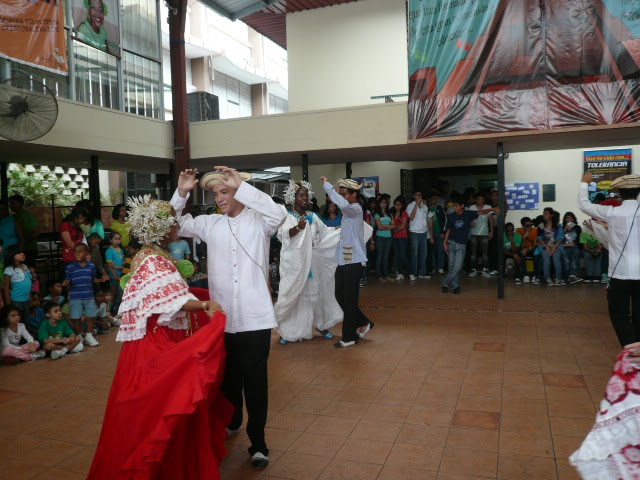
This has been some week at The Instituto! Yesterday was jean day and I didn't even know until I got to the school. My department was pretty quiet since the band and several teachers are in Costa Rica. The best part was the wonderful entertainment on the patio. I even made videos of two of the dances. Hope you enjoy them!
The dancer in white is our Bishop's daughter.


I love the motion of the dresses in the this group of pictures.


More later....

Friday, September 24, 2010

Friday Random Top Ten

Ya pushes "shuffle" and ya takes yer chances. . .

1. Talking Loud And Clear Orchestral Manoeuvres In The Dark
2. Remember A Day Pink Floyd
3. Original Sin Elton John
4. Tennessee Arrested Development
5. Shorty's Lament The Residents
6. Birthday The Beatles
7. Hanging On The Telephone The Nerves
8. I'll Shoot The Moon Tom Waits
9. Going Mobile The Who
10. Work A Day World Paul Collin's Beat

Geez, this is an Old Man's iTunes edition of Friday Random Top Ten! Nothing written or recorded in this century. None of these are the best songs by any of the artists. Well, Tennessee is one of the best things Arrested Development ever did, but otherwise this is a kinda pathetic old man's iTunes list! We did pretty well on the videos, though, with nine out of ten!

So, watchoo listenin' to?


Here's Arrested Development with Tennessee

Thursday, September 23, 2010

Thursday Miss Bebé, the World's Most Beautiful Granchile™ Blogging


Wearing Daddy's Hat!

Today at IESC

I know it's been a while since I've posted. I'm way behind on my pictures. So I'll start with todays group of photos from the school.

We had entertainment during the second recess and I was lucky that my student didn't show so I could enjoy it!

This is the dance I came in on.


This little group played some very nice music.

More good dancing. I love the tembleques.


Our boys in Drag. The pregnant boy/girl gave birth to a baby doll. The Drag queens were the final act and everyone, including the school Director enjoyed the act. They were very funny.


The band is preparing for their five day trip to Costa Rica.


That's it for now. Hopefully, I can catch up in the next few day.

Wednesday, September 22, 2010

Me and Faddah Butch

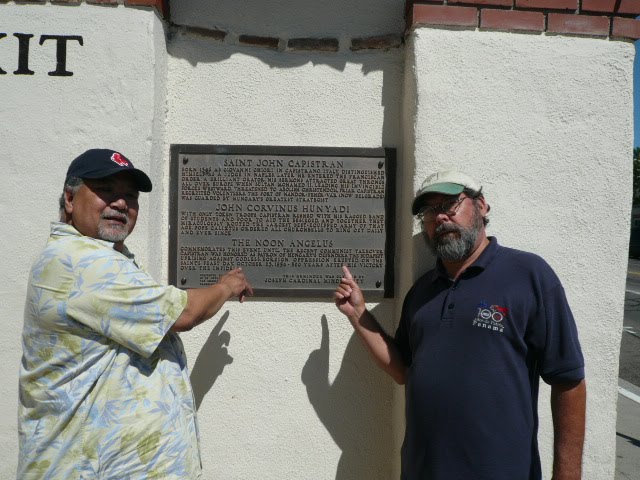
The Mad Priest gots a post making fun of my dear frein' an bruddah Faddahpriest Butchy's name. The Lovely Mona and I met da Faddah Priest at the Missionary Orientation Thang in Chicago back in July, 1999, as we were preparing to come to Panamá. Butchy is Panameño and trouble on the hoof, so we hit it off right away. The Lovely Mona said "Why is it that everywhere we go you find the other Bad Boy and hang out with him?" We called ourselves "the Faddah Priests" after a story he told us. When he was a newly ordained priest in the City of Colón many years ago, two young mens saw him standing in front of a tienda. One said, "Look dat man's hand!" The other young man said, "Dat's notta man, dat's a Faddah Priest!" We even did an act the last night of the Orientation as "Da Faddah Priests." I played the guitar and Butch just riffed on "Why Must I Be A Missionary Abroad?" to the tune of "Why Must I Be A Teenager In Love?" He and his wife and daughter were headed to the U.S. Virgin Islands and he wanted me to forget Panamá and head out with him! We have been bruddahs ever since. Here's a photo of us last year on our Sabbatical, at Mission San Juan Capistrano.
Dis guy is da bes'!

This Thing. . . The Final Frontier


These are the slices of the Star Ship Pizza-pie. Her five-slice mission: to explore strange new toppings, to seek out new cheeses and new sauces, to boldly burn the roof of mouths where no pizza has gone before.

Tuesday, September 21, 2010

Feast of St. Matthew, Apostle and Evangelist


We thank you, heavenly Father, for the witness of your apostle and evangelist Matthew to the Gospel of your Son our Savior; and we pray that, after his example, we may with ready wills and hearts obey the calling of our Lord to follow him; through Jesus Christ our Lord, who lives and reigns with you and the Holy Spirit, one God, now and for ever. Amen.


Matthew was an Apostle and Evangelist, as was John, and tradition states that he was also a martyr. Matthew's name appears in all four lists of the Twelve, so we can safely assume that he really was in that group, although he is also known as Levi. He was a Galilean, although Eusebius claims that Matthew was Syrian. Tradition states that Matthew preached to the Hebrews, and the Church Father Papias wrote that Matthew had written a collection of the sayings of Jesus in Aramaic. This collection of sayings in Aramaic may have been the basis for the gospel which bears his name.

Now, usually we don't really know much about the Apostles, they left no autobiographies for historians to use. What we know about Matthew comes from the gospels. He was a publican, a tax collector, an occupation despised by most Jews. Tax collectors were seen as collaborators with the Roman government, as extortionists who took money from their own people to help further the cause of the Roman oppressors and to line their own pockets. Most people hated tax collectors and saw them as traitors, and many of the most devout refused to marry into a family which had a tax collector in it. One can see the disgust for tax collectors in some of the passages we hear from the New Testament. Even Jesus used the name as a disparaging term; he said that when Christians have a dispute they are to try to work it out alone, and if that didn't work they were to bring a witness and try to work it out, and if that didn't settle things the offending person was to be treated like a Pagan or a Tax Collector. Since he was a tax collector Matthew was obviously not the kind of person anyone wanted to be seen with, yet when Jesus passed by his office, which was probably a stand like a kiosko, Jesus looked at Matthew sitting there and said, "Follow me." And Matthew dropped everything and followed Jesus. Jesus and the disciples came to Matthew's house for dinner, and many of Matthew's fellow tax collectors and friends came and joined Jesus and the disciples at table. Since Matthew was a social outcast, we can assume that his friends were, too, and the gospel calls them "sinners." When the Pharisees saw this group of outcasts sitting together, eating and talking and drinking wine and having a good time, they asked one of the disciples "What kind of example is this from your teacher, acting cozy with crooks and riffraff?" And when Jesus heard their question, he said, "Who needs a doctor, the healthy or the sick? Go figure out what this scripture means: 'I'm after mercy, not religion.' I'm here to invite outsiders, the sinners, not to coddle insiders!" I think that we all forget this at times, that we are all sinners and that Jesus came for sinners, not for those who are already perfect. The truth is, none of us are perfect, we are all sinners, we have all missed the mark, and Jesus came for all of us .So Jesus called Matthew, a tax collector and outcast, to follow him, and Matthew dropped everything and said "yes" to Jesus' call. In a way it's good that Matthew was already an outcast because becoming one of the Twelve, one of Jesus' followers, was going to keep him in that category.

As I said earlier, tradition states that Matthew was the apostle to the Hebrews, and that he wrote a collection of the sayings of Jesus. Scholars are not really sure whether the Apostle Matthew actually wrote the gospel attributed to him; it may bear his name because it contains his collection of sayings. One of the main characteristics of Matthew's gospel is the fullness with which it records the Lord's teaching; it has a special interest in the relation of the Gospel to Jewish Law, the Torah, with its stress upon Christianity being the New Torah. It also emphasizes the special commission given to Peter, and it contains the stories of the Resurrection appearances in Galilee. The Greek of Matthew's gospel is much more elegant than the Greek of Mark, and it also translates well into other languages. Because of this, it is the gospel most suitable for public reading, and for this reason it is probably the best known of the four gospels.

As is often the case with stories about the Apostles, there is some disagreement as to the rest of Matthew's life. There is a tradition that Matthew left Palestine to travel and preach, and that he wrote his gospel so that a witness would continue in his stead. The Roman Martyrology states that St. Matthew was martyred in Ethiopia, while the Hieronymianum, the martyrology of Asia Minor and Greece says that he was martyred in Persia in the town of Tarrium out on the Persian Gulf. Another tradition states that he suffered martyrdom in Pontus, and the town of Salerno in Italy claimed to have his relics.

The Martyrdom of St. Matthew

There is an apocryphal Acts and Martyrdom of St. Matthew, most probably of Gnostic origin, and it claims that Matthew was martyred in “Myrna,” wherever that is. I will tell you the story of St. Matthew’s martyrdom according to this text.

St. Matthew was on a mountain, resting, when he had a vision of the Christ Child and had a discussion with him about the fate of King Herod (“He dwells, indeed, in Hades; and there has been prepared for him fire unquenchable, Gehenna without end, bubbling mire, worm that sleeps not, because he cut off three thousand infants, wishing to slay the child Jesus, the ancient of the ages; but of all these ages I am father”). The child then instructs Matthew to go down the mountain to Myrna, the city of the man-eaters, and plant a rod next to the church Matthew and Andrew had founded. So, Matthew agrees to do so, and while entering the town he meets Fulvana, the wife of the king, and her son Fulvanus and his wife, Erva. All three of them were possessed by unclean spirits and cried out, “Who has brought you here again, Matthew? or who has given you the rod for our destruction? for we see also the child Jesus, the Son of God, who is with you. Do not go then, O Matthew, to plant the rod for the food, and for the transformation of the man-eaters: for I have found what I shall do to you. For since you drove me out of this city, and prevent me from fulfilling my wishes among the man-eaters, behold, I will raise up against you the king of this city, and he will burn you alive.” Matthew laid his hands on their heads and the demons were evicted and the people were made whole, and they followed him. Matthew went on into town and planted the rod as instructed and all manner of miracles took place, which we won’t get into here.

Now the king, Fulvanus, was happy when he learned that his wife and son and daughter-in-law had been delivered of their demons, but then he became jealous when he noticed that they were devoted to Matthew. His family had spent the night in the church with Matthew and the local bishop, Plato, and were baptized by Matthew. This increased Fulvanus’ jealousy and he decided to execute Matthew. It didn’t help that the demon Matthew had cast out of Queen Fulvana had taken on the form of a soldier and told Fulvanus that Matthew was a stranger and a sorcerer and a former tax collector, and was made an apostle by a person who was crucified, so why would you want your wife and son and daughter-in-law listening to the likes of him? The king agreed; he had no choice but to kill Matthew. Meanwhile, the Christ Child warned Matthew that the king’s men would be coming to get him. The king sent four soldiers after Matthew and Plato, but when they arrived at the church they heard voices but couldn’t see anyone, so they went back to the king to report that no one was there. This really made the king angry, so he sent ten more soldiers, who were man-eaters, and told them, “Sneak into the church and tear Matthew and Plato into pieces and eat them.” When the soldiers got to the church, they saw Matthew and Plato and the Lord Jesus, who was in the form of a beautiful boy holding a torch, which he used to burn their eyes! The soldiers ran back to the palace speechless. The king was really angry now, and he tried to get some advice on how to take Matthew from the demon/soldier, but the demon/soldier admitted that he, the demon, couldn’t do anything as God was protecting Matthew.

Now the story gets really strange: the king finds Matthew at the church and is struck blind. He cries out to Matthew to heal him, because God has decided that he wants Matthew in heaven now, and the king is to bury his body in their city as a testimony of salvation! So Fulvanus is healed and his sight is returned and he grabs Matthew by the hand and drags him to the seashore where executions take place. The king told the executioners that he heard that the God of Matthew saves those who believe in him from death by fire, but they’ll get around it by following his orders. He had them nail Matthew to the ground and cover him with paper smeared with dolphin’s oil and then cover him with brimstone and asphalt and pitch AND brushwood, and then light it all on fire. And if any of the Christians get in the way, they were to suffer the same fate. The executioners followed the king’s orders but when they put the fire to the highly flammable pile it turned to dew, and all the people watching cried out with one voice: “The only God is the Christians', who assists Matthew, in whom also we have believed: the only God is the Christians', who preserves His own apostle in the fire.” So the king had coals of fire taken from the furnace to be piled on Matthew. He also had idols of gold and silver brought to surround Matthew, to keep him from bewitching the fire. The entire pile was re-ignited, and Matthew looked up into heaven and prayed: “O God the Father, O Lord Jesus Christ, deliver me, and burn down their gods which they worship; and let the fire also pursue the king even to his palace, but not to his destruction, for perhaps he will repent and be converted.” When the king saw the flames rise higher and higher, he said, “Has your magic been of any help to you, Matthew? Can your Jesus help you now?” All of the sudden all the fire left Matthew and surrounded the idols instead. The fire melted the idols of gold and silver and also burned several soldiers to death. The king shouted “Woe is me! I should have used idols of stone, which don’t melt down!” The fire then took on the shape of a dragon and chased the king all over the place but wouldn’t let him find safety in the palace. Fulvanus ran back to Matthew and said, “I beseech you, whoever you are, O man, whether magician or sorcerer or god, or angel of God, whom so great a pyre has not touched, remove from me this dreadful and fiery dragon; forget the evil I have done, as also when you made me receive my sight.” Matthew forgave Fulvanus and actually called off the dragon, which disappeared, as did the flames. Matthew then looked up to heaven and prayed in Hebrew, commending his soul to the Lord and said, “Peace to you!” And, having glorified the Lord, he completed his martyrdom. Fulvanus took the body of Matthew and placed it on a golden bed. While they were bringing the bed back to the palace, all saw Matthew rise up to heaven, led by the beautiful boy, and twelve men in shining garments and wearing gold crowns met him. Everyone saw the beautiful boy crown Matthew, and in a flash of lightening all disappeared into heaven. And just when you thought the story couldn’t get any stranger, the king decided to put Matthew’s body in an iron coffin and throw it into the deepest part of the sea. Bishop Plato and others went to the church where they kept a vigil throughout the night. The next morning they came out of the church and saw Matthew standing on the water some seven furlongs from shore, accompanied by two men in shining garments and the beautiful boy. The king saw all this and ran out of the palace to the bishop and confessed in front of the bishop and priests and deacons that he believed in the True God, and in Jesus Christ, and asked to be baptized and given communion. After communion, Matthew appeared before them all. He told Fulvanus and his son that their names would be changed to Matthew, and that Fulvana’s named would be changed to Sophia, and Erva, the daughter-in-law’s name would be changed to Synesis. Then Matthew appointed the king a presbyter, and his son a deacon, and the queen a presbytress, and the daughter-in-law a deaconess. Then he blessed them and vanished. And they all went and destroyed all the idols and everyone in the kingdom became Christians. And King Matthew was given the gift of healing. And I’m exhausted after telling this story, as you probably are after reading it!

Tuesday, September 14, 2010

New Horizons In Evangelism


One should probably be very careful with this method, seeing how much God hates bacon.
Illustration nicked from Robert Warren's Facebook page

Friday, September 10, 2010

Feast of Alexander Crummell, Priest, Missionary, and Educator


Almighty and everlasting God, we thank you for your servant Alexander Crummell, whom you called to preach the Gospel to those who were far off and to
those who were near. Raise up in this and every land evangelists and heralds of your kingdom, that your Church may proclaim the unsearchable riches of our
Savior Jesus Christ, who lives and reigns with you and the Holy Spirit, one God, now and for ever. Amen.


Today is the feast of Alexander Crummell. He was an African-American and fought racism all of his life. He was born on March 3, 1819, in New York City. His father, Boston Crummell, was a former slave, while his mother, Charity Hicks, was a freeborn black woman. Both of his parents were very active in the Abolition Movement, and the first black newspaper, Freedom’s Journal, was published in their home. Their values guided him throughout his life. His father told him stories of his life back in Africa before he was captured, and these stories created a sense of unity with the people in Africa, as well as with those of African heritage in the Americas and throughout the world. He was also educated in Abolitionism by working with the American Anti-Slavery Society in New York during his youth. He was an intelligent person and one who wouldn’t take “no” for an answer. His tenacity and perseverance were important parts of his personality and were instrumental in his success.

Education was an important aspect of his success and drive, and his education started at home with private tutors and at the African Free School No. 2 in New York City. His secondary education was at Canal Street High School. Upon graduation from Canal Street, Alexander and his friend Henry Highland Garnet, another soon-to-be-famous Abolitionist, moved to New Hampshire to attend the Noyes Academy.
The school was eventually destroyed by a lynch mob. According to W.E.B. Du Bois in his essay “Of Alexander Crummell” in his book The Souls of Black Folk,
the “godly farmers hitched ninety yoke of oxen to the abolition schoolhouse
and dragged it into the middle of the swamp.” Crummell returned to New York and enrolled at the Oneida Institute. It was at the Oneida Institute that he experienced his call to the priesthood, and he applied to the General Theological Seminary in New York. However, he was denied admission because of his race; his grades were good, he had references, but General Theological Seminary was not yet ready to be integrated. W.E.B. Du Bois’ account of Crummell’s rejection is as follows: They were not wicked men,—the problem of life is not the problem of the wicked,—they were calm, good men, Bishops of the Apostolic Church of God, and strove toward righteousness. They said slowly, “It is all very natural—it is even commendable; but the General Theological Seminary of the Episcopal Church cannot admit a Negro.” And when that thin, half-grotesque figure still haunted their doors, they put their hands kindly, half sorrowfully, on his shoulders, and said, “Now,—of course, we—we know how you feel about it; but you see it is impossible,—that is—well—it is premature. Sometime, we trust—sincerely trust—all such distinctions will fade away; but now the world is as it is.” Then, as now, there were some in the leadership of the Church who believed that any change in favor of the outcast was “premature” and that the outcast should simply be patient until “things change naturally.” Of course, change of that nature doesn’t occur naturally; one must push and fight for such change, and Alexander Crummell was exactly the kind of person who would push for change.

He moved to Boston and studied for ordination. He did his field work as a missionary in Rhode Island and was ordained a priest by the Bishop of Delaware in 1842. He eventually ended up in the city of Philadelphia with a letter of recommendation from his bishop to Bishop Onderdonk of Philadelphia. According to W.E.B. Du Bois, Bishop Onderdonk told Father Crummell that he would be received into the diocese on one condition: that he not attend Diocesan Convention, and that no black church ask for representation in the Diocesan Convention. There was no way a person like Alexander Crummell could accept such conditions and he gave up on the Episcopal Church and, in 1847, moved his family to England. He travelled throughout the country, giving sermons and lectures about slavery in the United States. He was interested in studying at the great Universities of England, either the University of Oxford or the University of Cambridge. The opportunity presented itself and he grabbed it. He enrolled at Queen’s College, Cambridge, and was awarded a degree in 1853. He left England for Liberia, where he served as a missionary-educator. He was a professor at Liberia College. He believed that slavery and oppression had corrupted the “warm, emotional and impulsive energy” of the African race, and he believed that Liberia could serve as a model Christian nation. He was an advocate of Pan-Africanism;
he believed that in order to achieve their potential, Africans from the U.S. and the West Indies needed to unite with their brothers and sisters in Africa. He travelled through the U.S. and West Indies, recruiting highly-skilled and educated people of African heritage to resettle in Africa, in Liberia. His Pan-Africanist views offended the white missionaries in Liberia, and those Liberians of mixed-race, and they made life difficult for Crummell. He found the racism of the missionaries and biracial Liberians to be intolerable and finally returned to the United States in 1873.

He moved to Washington, D.C. where he was appointed “missionary at large of the coloured people.” In Washington he was able to finally realize his vision of a black church which is a place of worship and social service. In 1880 he established St. Luke’s Church, the church which helped him realize his vision. He continued to fight racism in the church and society, and when the Southern Bishops of the Episcopal Church proposed that a separate missionary district be created for black churches, he organized a national convocation to fight the proposal, which became a model for such convocations throughout the Episcopal Church.

Crummell continued to work on behalf of Black nationalism, and to encourage self-help and economic development among people of African heritage. The last years of his life were spent setting up the American Negro Academy, an organisation of black intellectuals dedicated to the promotion of higher education, arts, and science as part of the struggle for racial equality. People of African ancestry from around the world came together as the American Negro Academy, and it was the first society of blacks to specifically promote the ideas which W.E.B. Du Bois
articulated as the “Talented Tenth” (W.E.B. Du Bois was a founding member with the Rev. Crummell). Members of the American Negro Academy had backgrounds
in Law, Religion, Medicine, Literature, and Community Activism. The goal of the organisation was to “lead and protect our people” and to be “a weapon to secure equality and destroy racism.”

While he was unable to realize all of his vision, his personal achievements are impressive, but even more impressive is the influence he exerted on the Pan-African movement and on Black nationalism. He influenced Marcus Garvey, W.E.B. Du Bois, and Paul Dunbar. His work for equality in the Episcopal Church eventually led to the creation of the Union of Black Episcopalians. His faith in God inspired his tenacity and his determination to continue against all odds, against institutional racism and even racism in Liberia. He worked to set up the institutions and encouragement which would guide the struggle for civil rights and racial equality
in the United States of America and later the world. It is a struggle which continues and which his example inspires. I can't help but imagine the pride he would feel if he were here to see Barak Obama's candidacy, and the shock he would experience to realize that he is a candidate of the party which, during Crummell's lifetime, was the political party of Jim Crow and segregation, while the party influenced by Abolitionists has become the party of exclusion!

Alexander Crummell died the next year, in 1898. I will finish with the closing paragraphs of W.E.B. Du Bois’ essay: He sat one morning gazing toward the sea. He smiled and said, “The gate is rust on the hinges.” That night at star-rise a wind came moaning out of the west to blow the gate ajar, and then the soul I loved fled like a flame across the Seas, and in its seat sat Death.

I wonder where he is today? I wonder if in that dim world beyond, as he came gliding in, there rose on some wan throne a King, ---a dark and pierced Jew, who knows the writhings of the earthly damned, saying, as he laid those heart-wrung talents down, “Well done!” while round about the morning stars sat singing.

Wednesday, September 08, 2010

Feast of the Nativity of our Most Holy Lady the Θεοτοκυς


What is this sound of feasting that we hear?
Joachim and Anna mystically keep festival.
“O Adam and Eve,” they cry, “rejoice with us today:
For if by your transgressions you closed the gates of Paradise to those of old,
We have now been given a glorious fruit,
Mary the Child of God
Who opens its entrance to us all.”

Thy nativity, O Θεοτοκυς,
Has brought joy to all the world:
For from thee has shone fourth
The Sun of Righteousness, Christ our God.
He has loosed us from the curse and given the blessing:
He has vanquished death, and bestowed on us eternal life.

By thy holy nativity, O most pure Virgin,
Joachim and Anna were set free from the reproach of childlessness,
And Adam and Eve from the corruption of death.
Delivered from the guilt of sin,
Thy people keep the feast and sing:
“The barren woman bears the Θεοτοκυς,
the Sustainer of our life.”

Be renewed, O Adam, and be magnified, O Eve;
You prophets, dance with the apostles and the righteous;
Let there be common joy in the world
among angels and mortals
For the Θεοτοκυς is born today of
righteous Joachim and Anna.

Friday, September 03, 2010

Friday Random Top Ten


Ya pushes "shuffle" and ya takes yer chances. . .

1. Laus Trinitati (Hildegard von Bingen) Sequentia
2. Antiphon from Lauds of the Martyrs at Eastertide Monastic Choir of the Abbey of St. Peter, Solemes
3. Bring Back The Past Roky Erickson with Okkervil River
4. I Believe In Nothing Vivian Girls
5. Airport The Motors
6. Here's A Health To The Company (Drinking Song) The Chieftains
7. I Hate Heaven The Residents
8. The Day They Might Be Giants
9. Pulchare Sunt Genae Tuae (Palestrina) The Hilliard Ensemble
10. Positive Vibrations The Soft Boys

Well, that's one hella weird list! I pushed the "shuffle" after returning from blessing three homes, so I guess I was still exuding the odour of holiness and the shuffle went into some polyphony and plainchant. The Roky cut is from his newest album, which does not contain songs about aliens, zombies, and the devil. Vivian Girls is my favorite Girl Band right now. Ya can't go wrong with the Motors but I could do without the Cheiftains numbah, as well as the They Might Be Giants numbah, también. The Residents' song comes from their album Wormwood: Curious Stories From The Bible and is based on The Song of Solomon. Then we go all holy again with Palestrina and the Soft Boys and their Positive Vibrations. The first video is not Sequentia, but it is the correct piece. The Vivian Girls video is an acoustic guitar version of I Believe In Nothing. The Residents' video is interesting, to say the least!

Watchoo listenin' to?

Feast of Phoebe, Deaconess at Cenchreae

This is an edited version of my St. Pheobe sermon.

"I commend you to our sister Phoebe, a deacon of the church at Cenchraea, so that you may welcome her in the Lord as is fitting for the saints, and help her in whatever she may require from you, for she has been a benefactor of many and of myself, as well." So begins the sixteenth chapter of St. Paul's letter to the Christians in Rome. This is a very interesting verse, and one which has triggered a lot of conversation regarding the ordination of women, as it suggests that women did hold ordained offices in the earliest days of the Church. Today is the feast of Phoebe and we celebrate her ministry.

As is often the case with these first century saints, we do not know much about them, outside of their names being mentioned in Paul's epistles or their names appearing ion the martyrologies of that time. Phoebe is mentioned in the letter to the Romans, and different translations list her as either a deacon, a deaconess, a minister, or a helper, from Cenchreae, a city near Corinth, in Greece. The actual Greek text uses the word diakonon; there is no distinction between masculine or feminine forms in that word. Some have tried to say that a woman deacon was not a member of an actual holy order, unlike a male deacon, but I don't agree, because Paul's list of qualifications for deacons in 1 Timothy chapter 3 mentions both men and women: Deacons likewise must be serious, not double-tongued, not indulging in much wine, not greedy for money; they must hold fast to the mystery of the faith with a clear conscience. And let them first be tested; then, if they prove themselves blameless, let them serve as deacons. Women, likewise, must be serious, not slanderers, but temperate, faithful in all things. Let deacons be married only once, and let them manage their children and their households well; for those who serve well as deacons gain a good standing for themselves and great boldness in the faith that is in Christ Jesus. I read that as applying to both male and female deacons, but I know that the Roman Catholic church still thinks that the term deacon in this context means co-worker in the missionary enterprise. Phoebe is also described as a helper of Paul and many others, and it is quite possible that she was a Patroness of the house-church in Cenchreae; she may have owned the house in which the Christians of Cenchreae met, and that she took legal responsibility for the activities there. Some scholars believe that Paul's mention of her in the epistle to the Christians in Rome was a letter of recommendation to the Christians in Ephesus; perhaps Phoebe was moving from Cenchreae to Ephesus.

The office of Deaconess was mentioned by St. Paul in the letters to the Romans and to Timothy, but we also have evidence of the office in a letter from Pliny, a Roman governor who was writing to the Emperor Trajan for advice on dealing with Christians. He mentions two women ministers among the Christians in Bithynia. The office of Deaconess is also mentioned in the Apostolic Constitutions of Hippolytus, and the office developed greatly during the third and fourth centuries, although it is quite different from the office Phoebe held. The Council of Chalcedon, held in the year 451, legislated that women could become deaconesses at the age of 40. A deaconess was to devote herself to the care of sick and poor women; she was present at the interviews of women with bishops, priests, or male deacons (so that the clergy wouldn't be alone with strange women) and kept order in the women's part of the church. Her most important function was the assistance at the baptism of women. For the first five centuries of the Church, people were baptized naked, and so, for the sake of propriety, male deacons couldn't baptize women. When adult baptism became rare and was eventually replaced by infant baptism, he office of deaconess declined in importance. The office was actually abolished by the Council of Epaon in the year 517, but in the Nestorian Christian communities in Syria, and later in India and China, deaconesses administered Holy Communion to women and read the scriptures in public.

The Office of Deaconess was recovered in the 19th century, first by the Lutherans, and then by the Church of England and the Episcopal Church in the United States of America. In the Episcopal Church, the order was established by canon in 1898, with the support of the Rev. Dr. W.R. Huntington of New York. A Deaconess was to "Assist the minister in the care of the poor and sick, the religious training of the young and others, and the work of moral reformation." When I was doing research for my Master's thesis on the Standards of the Book of Common Prayer, I was surprised to discover that an office entitled Setting Apart of Deaconesses was developed for the 1928 Prayer Book. The joint Commission reports of 1916 and 1919 were both quite positive about the proposed service for the Setting Apart or Admission of Deaconesses and hoped that this service would be a means of acknowledging the work of so many women in the Church. The office was to contain this prayer, said by the bishop before he laid hands on their heads: O Eternal God, Father of our Lord Jesus Christ, Creator of man and woman; who didst anoint with the Spirit, Miriam and Deborah and Anna and Huldah; who didst not disdain that thine only begotten Son should be born of a woman; who, also, in the tabernacle of the testimony an din the temple, didst ordain women to be keepers of thy holy gates: Look mercifully, we beseech thee, upon these thy servants, about to be set apart to the office and work of Deaconess. Protect them in the way wherein they go, and grant that in singleness of purpose and with a willing mind they may worthily accomplish the task committed to them, to thy glory and to the praise of thy Christ, to whom with thee, O Father, and thee, O Holy Ghost, be glory and worship for ever and ever. Amen.* Unfortunately, while the members of the Joint Commission on the Book of Common Prayer were forward thinkers, the members of the General Convention of 1922 were not, and they made sure that the office Setting Apart or Admission of Deaconessess was not part of the 1928 Book of Common Prayer. Although the rite for Deaconesses was not part of the Prayer Book, the office was an important one in the Church; there was a School for Deaconesses in Berkeley, California: St. Margaret's House, which was affiliated with the Church Divinity School of the Pacific and the students of St. Margaret's House took classes at C.D.S.P. St. Margaret's House closed in the late 1960's when women were finally admitted to Episcopal seminaries. The office of Deaconess no longer exists now that we have women deacons, priests, and bishops.

I think that the fact that Phoebe was a deacon in the Church in Cenchreae is important because it shows that women were important to spreading the faith, and not only by working in the kitchen. Women owned house-churches, women administered and supervised the work with the poor and widows, women handled financial affairs for the churches, and women helped spread the gospel. Jesus came to turn everything upside down: the last would be first and the first would be last, and the Church was shaking up the society of Late Antiquity. Allowing women to serve as ministers was one way in which the Church illustrated the Reign of God. Unfortunately, they did not hold with it for very long, and cultural mores eventually superseded spiritual ideas, but because we have a historical record of women as ministers, we were eventually able to recover that office, and even move forward to the point that we are at now. Although there was much resistance to the ordination of women at first, and there is still resistance in some areas, I can't imagine a Church without women deacons, priests and bishops. My bishop back in the U.S.A. is a woman, the Rt. Rev. Mary Grey-Reeves. Some of the best priests from my class at seminary are women, and the Rev. Robbins Clark, Rector of St. Mark's, Berkeley, was very important in my formation as a priest and is a dear friend. Here in the Diocese of Panamá we have been blessed by the ministries of the Very Rev. Maizee Lenan, Revda. Carmen Saéz, Revda. Victoria Mina, Revda. Diana Parada, Revda. Canoniga Glenda McQueen, Revda. Becky Michelfelder, and Revda. Jane Surles. Think of the important ministries of our on-line friends: Revda. Canoniga Lee, Revda. Elizabeth, Revda. Susan, Revda. Jane, Revda. Kate, Revda. Jennifer, Revda. Margaret, Revda. Lois, Revda. Ann, Revda. Jan, Revda. Penelope, Revda. Paula, and all the others who keep the Anglican Blogosphere going! So let us give God thanks for the example of the life of Phoebe, Deacon, and of women clergy here in Panamá and throughout the Anglican Communion.

Enlightened by grace
And taught the Faith by the chosen vessel of Christ,
You were found worthy of the diaconate;
And you carried Paul’s words to Rome.
O Deaconess Phoebe, pray to Christ God
that his Spirit may enlighten our souls!
- Troiparion in Tone 3

*Report of the Joint Commission on The Book of Common Prayer Appointed by The General Convention of 1913. Boston:D.B. Updike, the Merrymount Press. 1916. p 156

I See You!

Sign by Danasoft - Get Your Free Sign